House Refurbishment Tring
Whole-house refurbishments in Tring, every floor of the house renewed from the roof down, in the right order.
- Rated 4.9 from 31 reviews on MyBuilder
- UK guide: £43,530 to £110,350
- Free site survey, itemised quote
House refurbishment in Tring means renewing the whole fabric of a freehold house without re-planning it: wiring, plumbing, heating, plaster, floors, joinery and the roof repairs the survey calls for. Across Tring and the villages its statistical areas take in, 88% of homes are houses and 20% were built before 1919, so a Tring job may be a Victorian terrace in the western streets or a post-war semi in Tring North. We run the strip out, first fix, plaster, second fix and finish as one programme, whether the house is empty or you are living in it.
For Tring, published UK figures put a three-bed house refurbishment at £43,530 to £110,350, with a London architect allowing £1,800 to £2,200 per square metre before VAT (Checkatrade and Bradley Van Der Straeten Architects, 2026). GS Renovation Ltd, a building contractor based in Potters Bar, does the work in Tring: we renew the wiring, pipework, heating, plaster, floors and joinery of the whole house under one contract, and a registered electrician certifies the rewire.
Price guide
| Work | Indicative range |
|---|---|
| Three-bed house refurbishment, UK average | £43,530 to £110,350 |
| Non-structural house refurbishment in London, per square metre, excluding VAT | £1,800 to £2,200 per square metre |
| Full rewire, two-bed to five-bed house | £4,500 to £10,500 |
| New heating system, three-bed house | £3,000 to £8,500 |
| Re-skim walls and ceilings, three-bed house | £5,000 to £12,500 |
Indicative ranges from published cost guides (Checkatrade, Bradley Van Der Straeten Architects and MyJobQuote, 2026), not a quotation. Most are UK-wide figures and London work usually costs more; a row marked London is a London figure. Hertfordshire prices follow a site visit. Prices checked September 2026. Full breakdown: House Rewire Cost.
Quick estimate from UK guide figures
Guide range: choose above
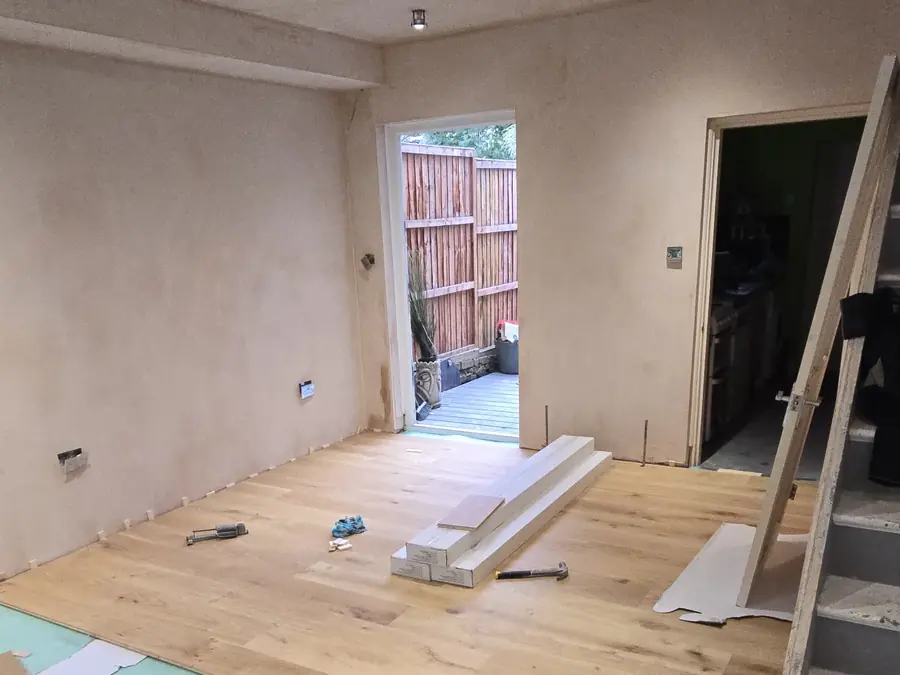
What a pre-1919 Tring house hides behind the plaster
Expect older fabric than the front suggests. Of the 7,420 dwellings counted across Tring and its immediate villages, 1,310 were built before 1900 and a further 180 between 1900 and 1918. On the western side of town, the statistical area covering Western Road and the old conservation streets has 740 of its 2,950 dwellings dating from before 1900, so the western side carries the heaviest share of original walls. Tring North is the opposite case: only 190 of its dwellings predate 1900, while 1,280 of its 2,180 were built between 1955 and 1982, so the work there is more often renewing post-war services than conserving old fabric.
In practice that means lath and plaster ceilings, lime mortar, old wiring and suspended timber floors whose joists have been notched by generations of pipe and cable runs. We open up a sample of walls and floors at the survey stage and price the repair from what is actually there. Gypsum patched onto a lime wall tends to crack along the joint and hold moisture, so we match the repair to the wall rather than the other way round.
Housing in Tring
Around 7,420 homes make up Tring on the valuation list; 12% are flats and 88% houses, and 20% date from before 1919, 6% from between the wars and 73% from after 1945. 31% of homes here are terraced; rewiring a terrace in Tring means noisy chasing on two shared walls.
Timber frames behind brick fronts on older Tring streets
An older town-centre house in Tring can be three buildings in one. The conservation area appraisal describes a pattern that repeats: a seventeenth century back wing framed in timber and infilled with brick, then an eighteenth century brick range, then an early nineteenth century front in brick or render that hides the older work. It adds that rear parts are frequently hard to see and may hold further early timber framing still to be discovered. A rewire or replaster in a house like that can uncover a frame nobody knew was there.
So the strip out goes slowly at the back of the house. We lift boards and take down plaster by hand where framing is likely, photograph what appears, and stop to agree a repair before anything is cut. Timber frames and brick nogging need breathable repairs, which usually means lime plaster and careful treatment of any decay rather than a board-and-skim finish. If the house is listed, listed building consent covers work inside as well as out, so the owner checks with Dacorum before the historic fabric is altered, and the programme allows for that pause.
Conservation area rules on render, flues and roofs in Tring
Inside Tring conservation area some ordinary refurbishment items need planning permission. Recladding or rendering any outside wall, whether in render, pebble dash, timber, tiles, plastic or stone, needs planning permission from Dacorum first. So does fitting, moving or renewing a chimney, flue or soil pipe where it sits on a street-facing principal or side elevation. A new boiler flue or soil stack is therefore a planning question on many front and side walls.
Roof work follows a rule that applies anywhere in England, and so here too: a roof alteration that stands proud of the original slope by more than 150mm, or lifts any part above the old ridge, needs planning permission. On top of those area-wide rules, the appraisal records Article 4 directions at 1 to 18 King Street and at Linwood and Farleigh in Park Road, among other addresses. We plan flue and vent routes to the back of the house where we can, and flag anything that needs the owner to ask Dacorum first.
Skips, scaffold and materials on a Tring street
Anything that goes on the road needs a county licence, and the lead times shape the start date. A Hertfordshire County Council skip licence usually takes 3 weeks to process. Scaffolding on a public road, verge or pavement needs a county licence, and hoarding needs one before it goes up. Working without a scaffolding licence risks a fine, so every licence is in place before any kit reaches the pavement of a Tring terrace with no front garden.
Materials stored on the carriageway are licensed only on lightly trafficked roads, with less than 20 vehicles in 3 minutes of two-way flow, and Herts Highways asks for at least 10 working days to process that licence. On a busy street we plan deliveries in smaller loads and keep materials inside the house instead, which changes how the strip out and the refit are staged. Waste goes out on the same visits, so rooms never fill with rubble between collections.
- Damp investigation, repair of the cause and making good
- Replacement windows to Approved Document L where sashes are beyond repair
- Loft insulation topped up while the tank space is cleared
VOA Council Tax stock of properties, March 2025, for Tring North, Tring East, Wigginton & Aldbury and Tring West & Long Marston. Counts rounded by the VOA.
Why Tring Homeowners Choose GS Renovation
A whole-house refurbishment runs through many trades in a fixed order, and delays usually come from the gaps between them. We run the strip out, first fix, plastering, second fix and decoration as one programme, with the electrics tested and certified by a registered electrician and any gas work done by a registered gas engineer. For probate, pre-sale or landlord work, we agree the scope in writing, keep you updated with photographs if you live elsewhere, and hand over a house that is ready to show, let or move into.
- Free, no-obligation quotations
- A top-floor-first programme when your family stays in the house
- Radiators, sockets and switches positioned at first fix, never after decorating
I am very happy to recommend George after he completed the work on my 2 bathrooms. He worked very hard to make sure everything was completed and even…
We loved working with George and Ibrahim and would highly recommend them. They have done splendid job on our new kitchen refurb which including new…
George is a very hard working builder, and has done a fantastic job on replacing my Bathroom. His attention to detail was great and I wouldn't…
FAQ
Frequently Asked Questions about House Refurbishment Tring
What should I budget for a full house refurbishment in Tring?
Start from the published UK range of £43,530 to £110,350 for a three-bed house (Checkatrade, 2026). Add a contingency for what only shows once plaster and floors are opened. The itemised quote after the Tring survey shows each trade separately, so the work can be phased if the total is more than you want to spend at once.
Do Tring house refurbishments need a licence for a skip on the road?
Yes, if the skip goes on a public road. A Hertfordshire County Council skip licence usually takes 3 weeks to process, so it needs applying for well before the strip out starts. Where the house has a drive or front garden big enough, the skip can go there and no road licence is needed.
Can replacement windows in a Tring house need building regulations approval?
Yes, in some cases. Hertfordshire Building Control counts work affecting means of escape in case of fire, including in some cases replacement windows in homes, as building work under the regulations. Replacement windows are normally self-certified by a FENSA or Certass registered installer, with a building control application only as the fallback. Windows that serve as an escape route keep a usable opening, and we check that before ordering.
What happens if earlier work on a Tring house was never approved?
It can be regularised. Hertfordshire Building Control uses a Regularisation Application for building work carried out without any application or notice to the council at the time. The owner applies, and inspectors may ask for parts of the work to be opened up. We can open up and make good as part of the wider refurbishment, which matters before a sale.
Should the sash windows in a Tring conservation area terrace be replaced?
Overhaul them first. The appraisal describes double hung sliding sashes in flat arch openings as typical of the western character area, and recommends an Article 4 direction to limit uPVC in the conservation area. That recommendation is not yet a direction in force, but repaired timber sashes keep the frontage consistent. At the King Street addresses where the appraisal records Article 4 directions, check with Dacorum first.
How much of Tring's housing is old enough to need lime-based repairs?
About one home in five. Across Tring and the villages its statistical areas take in, the VOA counts 20% of homes as built before 1919, when solid walls and lime mortar were normal. Those houses breathe through the fabric, so repairs in cement or gypsum can trap moisture. We use lime where the wall is lime, and modern materials where the house was built with them.
Does a new boiler flue on a Tring conservation area house need permission?
It can. In Tring conservation area, a new or replacement flue, chimney or soil pipe needs planning permission when it sits on a street-facing wall or roof slope forming the front or side of the house. A flue on the rear wall avoids that test, so we look for a rear route when the heating is renewed and the boiler moves.
Do trees need checking before refurbishment work in the Tring conservation area?
Yes, if the work touches a tree. Six weeks' notice to Dacorum is needed before anyone cuts down, tops or lops a tree in Tring conservation area whose trunk is over 75mm in diameter at 1.5 metres above the ground. The appraisal quotes 100mm, but national law sets 75mm, and 100mm applies only when thinning to help other trees grow, so give notice for any tree over 75mm. Scaffold, skips and access routes can all bring branches into play, so check the garden early.
Is radon something to plan for when refurbishing a house in Tring?
Not in the central streets the atlas covers. The BGS radon atlas places the grid squares covering the High Street, King Street, Park Road, Miswell Lane and Icknield Way entirely in the lowest band, with less than 1% of homes above the Action Level. When ground floors are relaid we still seal and ventilate them properly, because that protects the new floor from damp.
Every Service, One Team
More GS Renovation Services in Tring
One team for every GS Renovation service in Tring:
Same Service, Nearby Areas
House Refurbishment Near Tring
We carry out house refurbishment across Tring and the surrounding areas. Explore a nearby location:
Ready to Start Your Tring Project?
Free, no-obligation quote for house refurbishment in Tring.