House Refurbishment Harlow
Whole-house refurbishments in Harlow, every floor of the house renewed from the roof down, in the right order.
- Rated 4.9 from 31 reviews on MyBuilder
- UK guide: £43,530 to £110,350
- Free site survey, itemised quote
House refurbishment in Harlow is mostly work on New Town fabric. On the VOA figures 71% of the town's homes are houses, 50% are terraced and 98% date from after 1945. Renewing a house here means rewiring, replumbing and new heating behind render and brick, and in estates such as Mark Hall North under monopitch flat roofs, rather than lime and lath. We renew the whole house without re-planning it, with the council's covenant, any Article 4 direction and the highway licences settled before the strip out.
For Harlow, published UK figures put a three-bed house refurbishment at £43,530 to £110,350, with a London architect allowing £1,800 to £2,200 per square metre before VAT (Checkatrade and Bradley Van Der Straeten Architects, 2026). GS Renovation Ltd, a building contractor based in Potters Bar, does the work in Harlow: we renew the wiring, pipework, heating, plaster, floors and joinery of the whole house under one contract, and a registered electrician certifies the rewire.
Price guide
| Work | Indicative range |
|---|---|
| Three-bed house refurbishment, UK average | £43,530 to £110,350 |
| Non-structural house refurbishment in London, per square metre, excluding VAT | £1,800 to £2,200 per square metre |
| Full rewire, two-bed to five-bed house | £4,500 to £10,500 |
| New heating system, three-bed house | £3,000 to £8,500 |
| Re-skim walls and ceilings, three-bed house | £5,000 to £12,500 |
Indicative ranges from published cost guides (Checkatrade, Bradley Van Der Straeten Architects and MyJobQuote, 2026), not a quotation. Most are UK-wide figures and London work usually costs more; a row marked London is a London figure. Essex prices follow a site visit. Prices checked September 2026. Full breakdown: House Rewire Cost.
Quick estimate from UK guide figures
Guide range: choose above
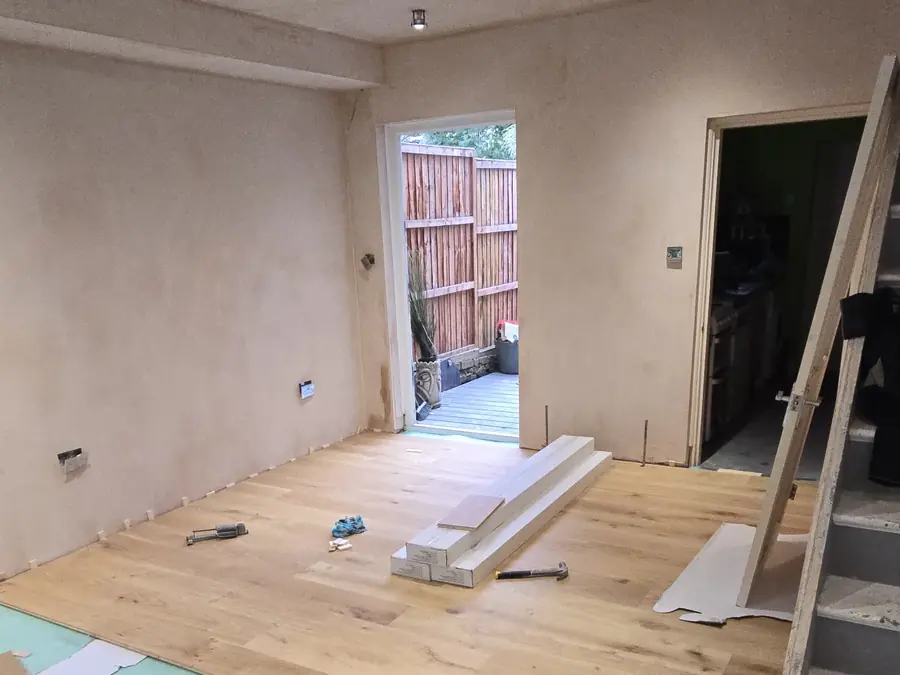
What a post-war Harlow house needs from a refurbishment
A Harlow refurbishment deals with post-war construction far more often than lath and plaster, because 98% of the homes date from after 1945. The Harlow Design Guide records that the town was built in housing groups of roughly 150 to 500 dwellings, each with its own style. Two houses a mile apart can therefore have different roofs, windows and wall build ups. We open up a small area first, check what the walls, floors and ceilings are really made of, and price the strip out against that rather than a standard specification.
The order of works on a whole house stays the same whatever the estate. We strip out, then run first fix: the rewire, which a registered electrician certifies, new pipework and the heating circuit, with any gas work done by a registered gas engineer. Walls and ceilings are then boarded or skimmed, second fix puts in sockets, radiators and sanitaryware, and joinery, flooring and decoration finish the job. The Harlow Local Development Plan ties the town's high share of terraced homes to its original master plan, so the mid terrace house is the one we plan around most.
Housing in Harlow
Of the 40,520 homes the valuation list records in Harlow, 1% were built before 1919, 1% between the wars and 98% since 1945; 29% are flats and 71% are houses. 50% of homes here are terraced; rewiring a terrace in Harlow means noisy chasing on two shared walls.
Roofs, render and chimneys on Mark Hall North houses in Harlow
In Mark Hall North, Harlow Council's appraisal records two storey houses built with monopitch flat roofs, and terraces in pastel render with exposed brick on the side elevations. A refurbishment there respects that finish: render patched or renewed in a matching colour, brick flanks repointed, and the flat roof covering treated as its own job. Where more than half of a roof is renovated, Part L of the building regulations normally expects its insulation to be upgraded, so the roof build up is settled before any ceiling below is boarded.
Chimneys need care in this conservation area. Since 28 October 2023 its Article 4 direction has required planning permission to install, alter or replace a chimney on any part of the house, though flues and soil pipes are outside it. Harlow Council's guidance says permanently removing a chimney there will not normally be acceptable unless it is dangerous or not original. A stack in poor condition is therefore repaired like for like, and any rebuild, alteration or removal waits for planning permission. On a terrace the stack is often shared, so repairing or rebuilding it needs a party wall notice under the Party Wall Act and the building owner serves the notice.
Old Harlow, Victorian streets and listed houses
The older fabric in Harlow is concentrated in a few places: 1% of homes predate 1919. Harlow Council's Old Harlow appraisal records that the largest area of late Victorian and early Edwardian house building lies east of Harlow, with much of Bury Road and New Road laid out between 1870 and 1901. Those houses bring problems the New Town stock does not. Lime mortar and plaster should be repaired with lime, timber ground floors need their air bricks kept clear, and old pipework and extended wiring may need replacing.
Harlow Council records 168 statutory listed buildings in the district, and it names the removal of historic doors, fireplaces, plasterwork or panelling as works that definitely need listed building consent. On a listed house the strip out list is agreed once consent is in hand, never decided on site with a crowbar. In Old Harlow the Article 4 directions also take away the right to remove, alter or put up a chimney. They also bring alterations to the front of the house facing the road into planning, so a new front door or porch is checked first.
Covenants, working hours and skips on a Harlow street
A Harlow house can need the council's covenant consent as well as building control. Harlow Council administers restrictive covenants on homes built by the Development Corporation and on homes it built for sale, and they can restrict external alterations. Its covenant fee schedule has a line for minor alterations and windows, so new windows, a changed front door or new cladding are checked against the title before they are ordered. Church Langley is the exception, where only the original developers' covenants apply.
Harlow gives permitted construction noise hours of 8.00am to 6.30pm Monday to Friday and 8.00am to 1.00pm on Saturday, so hacking off plaster and chasing for cables go inside those windows. A skip, scaffold or hoarding on a public road needs a licence from Harlow Council or Essex County Council, depending on who owns the road, and the largest skip allowed on the highway is a 6 yard skip. On a terrace with parking courts rather than drives, we plan several smaller skip swaps into the programme.
- Pre-sale and probate refurbishments of empty houses
- Staircase repairs: treads, risers, strings, balusters and newel posts
- Replacement windows to Approved Document L where sashes are beyond repair
VOA Council Tax stock of properties, March 2025, for all 11 statistical areas in Harlow. Counts rounded by the VOA.
Why Harlow Homeowners Choose GS Renovation
You get one contractor for the whole house: strip out, first fix, plastering, second fix and decoration, priced in a written quotation after we have seen the house. We check the covenant, any planning restrictions and the highway position before pricing, and set the order of works around whether you are living in the house or it stands empty. A registered electrician certifies the rewire and a registered gas engineer handles the boiler. Our founder, Abdelaaziz Saaid, has more than three decades of hands-on experience, and the same team sees the house through to the final coat.
- Empty and inherited houses secured and reported on while you are away
- Building control applications and inspections coordinated for you
- Radiators, sockets and switches positioned at first fix, never after decorating
Reviewed jobs near Harlow
1 MyBuilder review from Harlow, with each customer's own job title:
- Fit an integrated door and plinth on washing machine, Harlow, 18 Jun 2021 (5 out of 5)
Read all 31 on our reviews page.
George was a great find. The job required re-plastering the walls before fitting acrylic panels. He also re-plumbed the shower waste under the solid…
I am very happy to recommend George after he completed the work on my 2 bathrooms. He worked very hard to make sure everything was completed and even…
He was very very good. He just got on with the job and we was beey pleased with the result. He Also cleaned everything away when he finished. Will…
FAQ
Frequently Asked Questions about House Refurbishment Harlow
How much does a house refurbishment cost in Harlow?
Published UK figures put a three-bed house refurbishment at £43,530 to £110,350 (Checkatrade, 2026): a London architect allows £1,800 to £2,200 per square metre before VAT (Bradley Van Der Straeten Architects, 2026). For a Harlow house the survey decides where the job sits, from the wiring and pipework to the plaster, damp and roof. Each trade is then priced as its own line.
Does changing the windows on a Harlow house need covenant consent?
Possibly, so check the title before ordering. Harlow Council administers restrictive covenants on former Development Corporation and council-built homes, and its covenant fees include a line for minor alterations and windows, charged at a higher rate if you apply after the work. In Church Langley only the original developers' covenants apply. We specify the windows once the covenant position is known, so the order is not wasted.
Can a chimney stack be taken down on a Mark Hall North house in Harlow?
Not without planning permission, and removal is unlikely to be approved. The Mark Hall North Article 4 direction brings chimney works on all parts of a house into planning, and Harlow Council says permanent removal will not normally be acceptable unless the chimney is dangerous or not original. On a refurbishment there we repair the stack like for like and keep the flashings and pots in the original pattern.
What hours can noisy refurbishment work run in Harlow?
From 8.00am to 6.30pm Monday to Friday and 8.00am to 1.00pm on Saturday. Those are Harlow's permitted construction noise hours, and on a terrace the neighbours share your party walls, so they hear every chase and every breaker. We put stripping, chasing and floor lifting inside those hours and keep quieter work, such as decorating, for the rest of the day.
Who licenses a skip or scaffold on a road in Harlow?
Harlow Council or Essex County Council, whichever owns the road. A skip, scaffold or hoarding on the public highway needs a licence from the right one, and a Harlow Council licence runs for 14 days unless renewed. On a longer refurbishment we plan renewals into the programme so the licence never lapses mid job, or keep the skip on the drive where there is room.
How much pavement must scaffolding leave clear in Harlow?
At least 1.5 metres of width and a 2.1 metre overhead clearway on a footpath. On a narrow New Town path that can decide whether a front elevation is scaffolded conventionally or with a gantry over the walkway. We measure the path on the first visit so the scaffold design, the licence and the programme all agree before anything is booked.
How do materials reach the back of a mid terrace house in Mark Hall North?
Often through the access tunnel in the row. Harlow Council's appraisal records that terraced rows in Mark Hall North were built with tunnels giving pedestrian access from the front to the rear gardens. Plasterboard, timber and rubble bags go through that tunnel by hand, so we allow labour for it in the price and protect the tunnel walls and the neighbours' share of it.
Can we stay in the house during a full refurbishment?
Yes, if the work is phased, though an empty house is quicker. Living in, we keep one bathroom and a basic kitchen running while other rooms are stripped, and bring the rewire and heating in stage by stage so power and hot water are off for short, planned periods. Dust sheeting and sealed doorways protect the rooms you use. Empty, every trade can run through the whole house at once.
Can a house be refurbished for sale after probate?
Yes. Executors often want the house cleared, made sound and freshened for the market without a redesign, and we work to that brief. We deal with any defects a buyer's surveyor would flag, then have a registered electrician test or rewire the electrics, service the heating, replaster where needed, lay new floor coverings and redecorate. The executors get one written quotation, one programme and regular photographs if they live away.
Every Service, One Team
More GS Renovation Services in Harlow
One team for every GS Renovation service in Harlow:
Same Service, Nearby Areas
House Refurbishment Near Harlow
We carry out house refurbishment across Harlow and the surrounding areas. Explore a nearby location:
Ready to Start Your Harlow Project?
Free, no-obligation quote for house refurbishment in Harlow.