House Refurbishment Epping
Whole-house refurbishments in Epping, every floor of the house renewed from the roof down, in the right order.
- Rated 4.9 from 31 reviews on MyBuilder
- UK guide: £43,530 to £110,350
- Free site survey, itemised quote
House refurbishment in Epping is mainly work on post-war houses: 77% of the town's homes are houses, and the VOA dates 73% of all homes after 1945. The older stock sits around a Georgian and Victorian High Street, with 14% of homes built before 1919 and 13% between the wars. Refurbishing a house here means renewing its wiring, plumbing, heating, plaster, floors and joinery without re-planning the rooms, in a sequence that suits whether you are living in it or it stands empty.
For Epping, published UK figures put a three-bed house refurbishment at £43,530 to £110,350, with a London architect allowing £1,800 to £2,200 per square metre before VAT (Checkatrade and Bradley Van Der Straeten Architects, 2026). GS Renovation Ltd, a building contractor based in Potters Bar, does the work in Epping: we renew the wiring, pipework, heating, plaster, floors and joinery of the whole house under one contract, and a registered electrician certifies the rewire.
Price guide
| Work | Indicative range |
|---|---|
| Three-bed house refurbishment, UK average | £43,530 to £110,350 |
| Non-structural house refurbishment in London, per square metre, excluding VAT | £1,800 to £2,200 per square metre |
| Full rewire, two-bed to five-bed house | £4,500 to £10,500 |
| New heating system, three-bed house | £3,000 to £8,500 |
| Re-skim walls and ceilings, three-bed house | £5,000 to £12,500 |
Indicative ranges from published cost guides (Checkatrade, Bradley Van Der Straeten Architects and MyJobQuote, 2026), not a quotation. Most are UK-wide figures and London work usually costs more; a row marked London is a London figure. Essex prices follow a site visit. Prices checked September 2026. Full breakdown: House Rewire Cost.
Quick estimate from UK guide figures
Guide range: choose above
What the age of an Epping house means for its refurbishment
A refurbishment in Epping deals with post-war fabric more than anything else: the VOA puts 73% of homes after 1945, 13% between 1919 and 1939 and 14% before 1919, with 14% built in 2000 or later. Each band opens up differently. Pre-1919 houses bring lime mortar, lath and plaster ceilings and solid walls that need to stay breathable, so cement render and gypsum skims on them trap damp. Interwar semis bring old lead or iron pipework, and wiring that has been added to rather than replaced.
Post-war estates carry their own signs. Theydon Grove, off Palmer's Hill, is one example: the 19th century country house of that name was demolished in 1964 and replaced with a housing estate. On houses of the 1960s and 1970s we test textured ceiling coatings and old floor tiles before anything is stripped, because some of those products contained asbestos. Homes built since 2000 usually need less fabric repair, so the work tends to be kitchens, bathrooms, finishes and heating controls.
Housing in Epping
For Epping the Council Tax list gives about 6,120 homes; by type 23% flats and 77% houses, by age 73% post-war, 13% interwar and 14% older than 1919. 28% of homes here are semi-detached; a semi in Epping has a single party wall, so one neighbour hears the chasing.
Cottis brick, clay tiles and the outside of an Epping house
Many Epping houses are built of local brick, and that shapes how the outside is repaired. The Epping Town Neighbourhood Plan records that there are still many houses in the town built from Cottis bricks, made at the family brickworks next to the station. When a refurbishment includes repointing, chimney-stack repairs or making good after a new soil pipe, we match the brick and the mortar rather than patching with whatever is to hand. On an older wall that means a mortar softer than the brick, so the face does not spall.
In the Epping Conservation Area, which covers the centre of the town, the outside of the house is controlled as well. Cladding the exterior in render, timber, plastic or tiles needs planning permission in any conservation area in the district, and the area's management plan discourages uPVC, untreated aluminium and concrete roof tiles. When windows or a roof covering are replaced there, we price timber joinery and clay tiles or slate to match what the house has. A listed house also needs listed building consent for those changes, and for works inside it that affect its character.
Building regulations and inspections on an Epping house refurbishment
Much of a refurbishment in Epping is notifiable even with no extension involved. Epping Forest District Council lists replacing windows and doors, replacing pitched or flat roof coverings, installing a bathroom with plumbing, replacing a fuse box and installing or replacing a heating system among the jobs that may need building regulations approval. You do not need to get approval yourself where the work is done by someone registered with a competent person scheme, so we use registered trades for those items and pass you the certificates.
Where an item does need an application in Epping, such as insulating a roof that is being re-covered or new drainage for a bathroom, the council's own building control service can handle it from the Civic Offices at 323 High Street. A registered building control approver is the alternative. The council can carry out a same day inspection on current and valid work if you book before 10am, although it prefers 24 hours notice. We book inspections at the stages the inspector needs to see, such as open joists and new insulation before boarding, so nothing is opened up twice.
Working hours, skips and phasing on an Epping street
Noisy stages of a house refurbishment in Epping run inside the hours Epping Forest District Council treats as normal for construction: 8am to 6pm Monday to Friday and 8am to 1pm on Saturday, with no noisy works on Sundays or Bank Holidays. Strip out, chasing walls for new cables and lifting floors are the loud weeks, so we put them early in the programme and tell the neighbours when they start. A skip on the road needs a permit from the highway authority, and on a narrow terraced street a bag collected the same day can suit better.
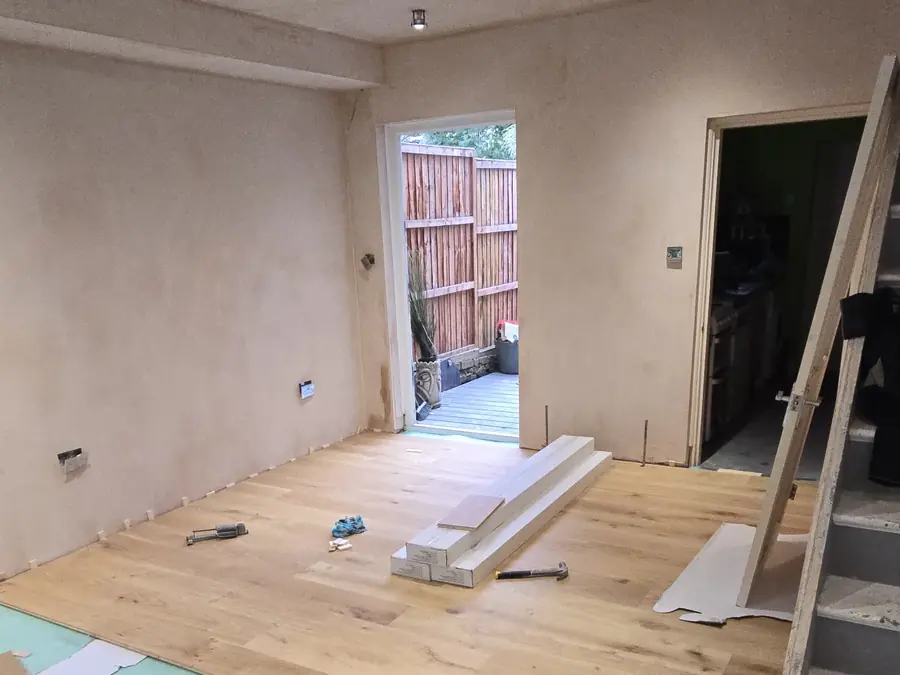
Whether you live in the house during the work changes the programme more than anything else. In an empty Epping house the whole place is stripped at once, first fix runs through every room, and plastering follows in one pass before second fix and decoration. If you stay in, we work floor by floor, keep one bathroom and a kitchen tap running, and seal dust off with temporary screens. That takes longer, but it avoids renting elsewhere. For a probate or pre-sale house we agree the finish date first and work back from it.
- Timber repairs where rot or beetle turns up at strip-out
- Pre-sale and probate refurbishments of empty houses
- Whole-house rewires, certified at completion by a registered electrician
VOA Council Tax stock of properties, March 2025, for Epping North and Epping South. Counts rounded by the VOA.
Trusted House Refurbishment in Epping
A house refurbishment is a chain of trades, and the order decides the finish. We survey the house, open up floors or ceilings where the survey calls for it, and give you a written quotation for the house as it really is. Strip out, repairs, first fix, plaster, second fix and decoration then run on one programme with one contact. A registered electrician certifies the rewire and an engineer on the Gas Safe Register does any gas work. The business is founder-led, so the person who priced the job is the one you talk to on site.
- Every wall of the house tapped and every circuit tested before the refurbishment is priced
- First fix cabling on each floor inspected by the electrician before the walls are closed
- Waste cleared as we go, not left piled up outside
George was a great find. The job required re-plastering the walls before fitting acrylic panels. He also re-plumbed the shower waste under the solid…
I am very happy to recommend George after he completed the work on my 2 bathrooms. He worked very hard to make sure everything was completed and even…
Excellent service. George's knowledge and skills are the best in the market. He knows what he is doing, does really high quality work, gives good…
FAQ
Frequently Asked Questions about House Refurbishment Epping
How much does a house refurbishment cost in Epping?
Published UK figures put a three-bed house refurbishment at £43,530 to £110,350 (Checkatrade, 2026): a London architect allows £1,800 to £2,200 per square metre before VAT (Bradley Van Der Straeten Architects, 2026). For a Epping house the survey decides where the job sits, from the wiring and pipework to the plaster, damp and roof. Each trade is then priced as its own line.
What hours can house refurbishment work run in Epping?
Noisy work belongs between 8am and 6pm Monday to Friday and 8am to 1pm on Saturday, which is what Epping Forest District Council treats as normal for construction noise. There should be no noisy works on Sundays or Bank Holidays. Quiet tasks such as decorating can run a little outside those hours, and we warn next door before the loudest days.
Do replacement windows in an Epping house need building regulations approval?
They may. The council lists replacing windows and doors among the alterations that may need building regulations approval, alongside roof coverings, heating systems and fuse boxes. You do not need to get approval yourself where the installer is registered with a competent person scheme, and the installer's scheme issues the certificate you keep with the house deeds.
How should an older Epping house be repaired without causing damp?
With materials that let the walls breathe. 14% of Epping homes were built before 1919, and on those solid walls lime mortar and lime plaster are the right repair, not cement render or gypsum. Cement traps moisture in the brick, which then shows as damp inside and spalling outside. We match the original mortar where it is exposed and leave sound old plaster in place.
Do you need consent to render or clad a house in Epping?
In a conservation area, yes. In the Epping Forest district, cladding the exterior of a house in stone, artificial stone, pebble dash, render, timber, plastic or tiles needs planning permission there. Outside a conservation area the rules are looser, but render over old brick still needs care, and a listed building needs listed building consent either way. We check the address against the designations before pricing any external finish.
Can you refurbish an Epping house before a sale or after probate?
Yes. For a sale, the aim is to fix what a buyer's survey will find, such as damp, tired electrics and a failing boiler, and then present the rooms cleanly. For a probate property we can take instructions from the executors, work to an agreed finish date and keep the house secure while it is empty. Both start with a site visit and a written quotation.
Is there an Article 4 direction affecting houses in Epping town?
Not a published one. The council's area directions cover sites at Loughton, Waltham Abbey, Nazeing and Sheering, and another covers the St John's conservation area in Buckhurst Hill. In the centre of Epping it is the conservation area that shapes the outside of a house, because its management plan discourages uPVC, untreated aluminium and concrete roof tiles.
Do trees near an Epping house affect a refurbishment?
They can, inside a conservation area. There you must give the council six weeks notice before cutting down, topping or lopping a tree with a trunk over 75 mm in diameter, measured 1.5 metres above the ground. If a branch blocks the scaffold or a skip position, that notice goes in before the start date, or the scaffold is designed around the tree instead.
Can you stay in your house while it is fully refurbished?
Often, if the work is phased. We finish one floor or one half of the house at a time, keep a working bathroom and water supply, and put up dust screens at each boundary. The rewire and the replumb are the hard weeks, because power and water go off for periods, so we agree those days with you in advance.
Every Service, One Team
More GS Renovation Services in Epping
One team for every GS Renovation service in Epping:
Same Service, Nearby Areas
House Refurbishment Near Epping
We carry out house refurbishment across Epping and the surrounding areas. Explore a nearby location:
Ready to Start Your Epping Project?
Free, no-obligation quote for house refurbishment in Epping.