House Refurbishment Ware
Whole-house refurbishments in Ware, every floor of the house renewed from the roof down, in the right order.
- Rated 4.9 from 31 reviews on MyBuilder
- UK guide: £43,530 to £110,350
- Free site survey, itemised quote
House refurbishment in Ware means renewing the fabric of a whole house without re-planning it: rewiring, replumbing, heating, plaster, floors, joinery, windows and decoration, run as one programme. The VOA list shows 12% of homes in Ware built before 1919, 8% between the wars and 79% after 1945, and 24% of homes are terraced houses while 39% are semi-detached or detached. On those figures a post-war house needing new services is the likelier job, while the smaller historic core brings lime, timber and plaster repair.
For Ware, published UK figures put a three-bed house refurbishment at £43,530 to £110,350, with a London architect allowing £1,800 to £2,200 per square metre before VAT (Checkatrade and Bradley Van Der Straeten Architects, 2026). GS Renovation Ltd, a building contractor based in Potters Bar, does the work in Ware: we renew the wiring, pipework, heating, plaster, floors and joinery of the whole house under one contract, and a registered electrician certifies the rewire.
Price guide
| Work | Indicative range |
|---|---|
| Three-bed house refurbishment, UK average | £43,530 to £110,350 |
| Non-structural house refurbishment in London, per square metre, excluding VAT | £1,800 to £2,200 per square metre |
| Full rewire, two-bed to five-bed house | £4,500 to £10,500 |
| New heating system, three-bed house | £3,000 to £8,500 |
| Re-skim walls and ceilings, three-bed house | £5,000 to £12,500 |
Indicative ranges from published cost guides (Checkatrade, Bradley Van Der Straeten Architects and MyJobQuote, 2026), not a quotation. Most are UK-wide figures and London work usually costs more; a row marked London is a London figure. Hertfordshire prices follow a site visit. Prices checked September 2026. Full breakdown: House Rewire Cost.
Quick estimate from UK guide figures
Guide range: choose above
Refurbishing a post-war Ware house room by room
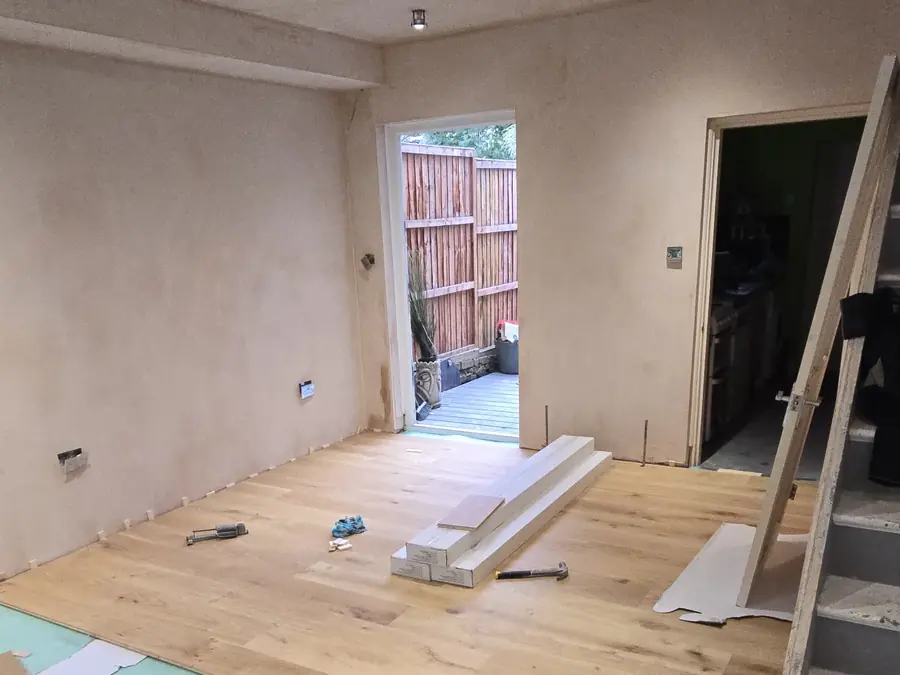
A refurbishment of a post-war Ware house is mostly a services and finishes job, and the order of work is what keeps it on programme. The VOA figures put 79% of the town's homes after 1945. Many houses of that age have brick cavity walls and solid ground floors, so the budget goes into what has worn out: consumer units and circuits, boilers and pipework, windows, kitchens, bathrooms and tired plaster. Some early post-war homes are non-traditional concrete construction, which needs a specialist survey before major work.
We strip out first and look before we price the extras. Old surface mounted cable, undersized pipework or hidden damp behind a skirting only show once the finishes are off. We record what we find with photographs, agree any change in writing, and then run first fix plumbing and electrics, plastering, second fix and decoration in that order. A registered electrician tests and certifies the new wiring at the end, and a registered gas engineer commissions any new boiler.
Housing in Ware
Ware's housing, as the Council Tax list records it, is about 8,980 homes: 66% houses, 34% flats, with 12% pre-1919, 8% interwar and 79% built since 1945. 27% of homes here are semi-detached; a semi in Ware has a single party wall, so one neighbour hears the chasing.
When a later brick front hides an older frame in Ware
In the oldest part of Ware, a refurbishment has to find out what the building really is before walls are stripped. The Ware Conservation Area Appraisal records that it is quite common for early timber framed buildings in the town to have been refaced in later materials and given later facades. A brick front can therefore stand in front of a timber frame, possibly with lath and plaster, lime mortar and oak behind it.
That changes the materials list. Gypsum plaster and cement render trap moisture against old timber, so repairs to a framed building use lime and breathable finishes. It also changes the paperwork. A listed building needs listed building consent for work that affects its character, inside or out, and railings and walls in its curtilage that pre-date 1948 carry the same controls. In the Ware Conservation Area, external changes can need planning permission. We open up carefully, stop if we find historic fabric the drawings did not show, and report it to you and your designer.
Windows, chimneys and trees on an older Ware house
The outside of an older Ware house is where refurbishment meets local policy. Ware Neighbourhood Plan Policy W2 asks development proposals to retain and where possible restore built historical features, naming windows and chimneys alongside iron railings, boundary walls and original malting features. So on a house in the historic core, the first question for tired sashes is repair, with splice repairs, new cords and draught seals, before anyone talks about replacement. Where a window does need renewing, your designer confirms what consent it needs before we order joinery.
Chimneys need the same care, because a stack can be shared. The list description for No. 3 Baldock Street, which is Grade II listed, records a cruciform narrow brick chimneystack set diagonally that also serves No. 5. Repairing or rebuilding a shared stack needs a party wall notice under the Party Wall etc. Act, so the building owner serves notice and the work goes ahead on the neighbour's written consent or an award. Listed building consent is checked for a listed stack. Garden trees matter too: in a conservation area such as Ware, six weeks notice goes to East Herts District Council under a Section 211 notice before work on a tree with a trunk diameter greater than 75mm.
Working hours, parking and skips on a Ware house job
Noisy work on a Ware house runs inside the hours East Herts sets out: 08:00 to 18:00 Monday to Friday and 08:00 to 13:00 Saturday, with none on Sundays or public holidays. Strip out, breaking and cutting are programmed into those windows, and quieter tasks such as decorating fill the rest. East Herts also asks anyone planning construction or demolition works to submit a Section 61 Prior Consent Application Form to environmental health.
Street access is planned separately. A skip on the highway needs a licence from Hertfordshire County Council, not a parking dispensation, so we hire the skip from a supplier who obtains the county licence. Where scaffolders or deliveries need bays, East Herts parking dispensations last no longer than seven consecutive days, cover no more than three vehicles and need at least 2 working days' notice, so we book them against the programme. Neighbours get a note before work starts.
- Panelled doors eased and rehung, skirtings and architraves pieced in to match
- Replacement windows to Approved Document L where sashes are beyond repair
- Sash boxes overhauled with new cords, parting beads and brush seals
VOA Council Tax stock of properties, March 2025, for Ware East and Ware West. Counts rounded by the VOA.
Why Ware Homeowners Choose GS Renovation
We take a house refurbishment from strip out to handover under one programme, so you are not coordinating separate trades. You get a written quotation after a site visit, a written sequence of works, and photographs of anything hidden that we uncover. The trades that must certify their work do so: a registered electrician for the wiring and a registered gas engineer for any gas appliance. We keep the site tidy for neighbours and leave a clean, finished house.
- Neighbours given notice before the noisy stages
- Provisional sums for what lies behind the plaster shown as separate lines
- Radiators, sockets and switches positioned at first fix, never after decorating
George was a great find. The job required re-plastering the walls before fitting acrylic panels. He also re-plumbed the shower waste under the solid…
I am very happy to recommend George after he completed the work on my 2 bathrooms. He worked very hard to make sure everything was completed and even…
Punctual, worked hard, and did exactly what he was asked and what he said he would do. Overall, a very high quality job. Will use again.
FAQ
Frequently Asked Questions about House Refurbishment Ware
How much does a house refurbishment cost in Ware?
Published UK figures put a three-bed house refurbishment at £43,530 to £110,350 (Checkatrade, 2026): a London architect allows £1,800 to £2,200 per square metre before VAT (Bradley Van Der Straeten Architects, 2026). For a Ware house the survey decides where the job sits, from the wiring and pipework to the plaster, damp and roof. Each trade is then priced as its own line.
What hours can house refurbishment work run in Ware?
Noisy work should run from 08:00 to 18:00 Monday to Friday and 08:00 to 13:00 on Saturday, with none on Sundays or public holidays. That is the limit East Herts expects for construction and demolition noise. Quiet work such as decorating or second fix joinery can be arranged around those hours, and neighbours hear from us before work starts.
Does a refurbishment skip in Ware need a licence?
Yes, if the skip sits on the road or pavement. In East Herts a skip on the highway needs a licence from Hertfordshire County Council rather than a parking dispensation. The skip supplier normally holds or applies for the licence. A skip on your own drive or front garden needs no highway licence.
Can scaffolders and vans get parking dispensations in Ware?
Usually, yes. East Herts generally grants parking dispensations for scaffolding works and building maintenance. Each lasts no longer than seven consecutive days, covers no more than three vehicles and needs at least 2 working days' notice. On a longer job, further applications are planned in step with the programme.
Why does an old house in Ware need lime rather than gypsum?
Because some older buildings in Ware are timber framed behind a later brick front. The Ware Conservation Area Appraisal records that early timber framed buildings in the town were quite commonly refaced with later facades. Timber and lath need walls that can dry out, and lime lets moisture escape where gypsum and cement trap it.
Should old sash windows in Ware be repaired or replaced?
Repair comes first on an older house. Ware Neighbourhood Plan Policy W2 asks proposals to retain and where possible restore built historical features, and it names windows and chimneys among them. A sash with sound timber can take new cords, draught seals and splice repairs. Replacement is a design and consent question your designer settles before joinery is ordered.
Can a shared chimney stack be repaired during a house refurbishment?
Yes, with the neighbour on board. Some stacks in Ware serve two houses: the listed stack at No. 3 Baldock Street is recorded as also serving No. 5. Repairing or rebuilding a shared stack needs a party wall notice under the Party Wall etc. Act, so the building owner serves notice and the work proceeds on written consent or a surveyor's award. Listed building consent is checked where the house is listed.
Do garden trees in Ware affect a house refurbishment?
They can, if scaffold, skips or new drainage come near them. In a conservation area such as Ware, six weeks notice must be given to East Herts District Council under a Section 211 notice before work on a tree with a trunk diameter greater than 75mm. Trees already under a Tree Preservation Order need consent instead. That notice is built into the start date.
Can you refurbish a house before sale or after probate?
Yes. Pre-sale and probate jobs usually focus on clearing the house, putting right defects a surveyor would flag, and a neutral finish throughout. We agree a clear scope and a written quotation with the executors or seller, and work to a date if a sale is already agreed. An empty house can be stripped and serviced in one pass, which shortens the programme.
Every Service, One Team
More GS Renovation Services in Ware
One team for every GS Renovation service in Ware:
Same Service, Nearby Areas
House Refurbishment Near Ware
We carry out house refurbishment across Ware and the surrounding areas. Explore a nearby location:
Ready to Start Your Ware Project?
Free, no-obligation quote for house refurbishment in Ware.