House Refurbishment Whitechapel
Whole-house refurbishments in Whitechapel, every floor of the house renewed from the roof down, in the right order.
- Rated 4.9 from 31 reviews on MyBuilder
- UK guide: £43,530 to £110,350
- Free site survey, itemised quote
House refurbishment in Whitechapel is a small part of the local work, and it is worth saying so plainly. The valuation list count for the wider Whitechapel and Spitalfields area puts 8% of homes as houses, every one of them terraced, with no semi-detached or detached houses at all. Those terraces sit in the Georgian and Victorian streets found among the post-war estates and modern apartments. Refurbishing one means renewing the whole fabric of a tall, narrow house: wiring, pipework, heating, plaster, floors, stairs, joinery and windows, in an order that suits a tight street and weekday working hours.
For Whitechapel, published UK figures put a three-bed house refurbishment at £43,530 to £110,350, and London houses usually cost more, with a London architect allowing £1,800 to £2,200 per square metre before VAT (Checkatrade and Bradley Van Der Straeten Architects, 2026). GS Renovation Ltd, a building contractor based in Potters Bar, does the work in Whitechapel: we renew the wiring, pipework, heating, plaster, floors and joinery of the whole house under one contract, and a registered electrician certifies the rewire.
Price guide
| Work | Indicative range |
|---|---|
| Three-bed house refurbishment, UK average | £43,530 to £110,350 |
| Non-structural house refurbishment in London, per square metre, excluding VAT | £1,800 to £2,200 per square metre |
| Full rewire, two-bed to five-bed house | £4,500 to £10,500 |
| New heating system, three-bed house | £3,000 to £8,500 |
| Re-skim walls and ceilings, three-bed house | £5,000 to £12,500 |
Indicative ranges from published cost guides (Checkatrade, Bradley Van Der Straeten Architects and MyJobQuote, 2026), not a quotation. Most are UK-wide figures and London work usually costs more; a row marked London is a London figure. Prices checked September 2026. Full breakdown: House Rewire Cost.
Quick estimate from UK guide figures
Guide range: choose above
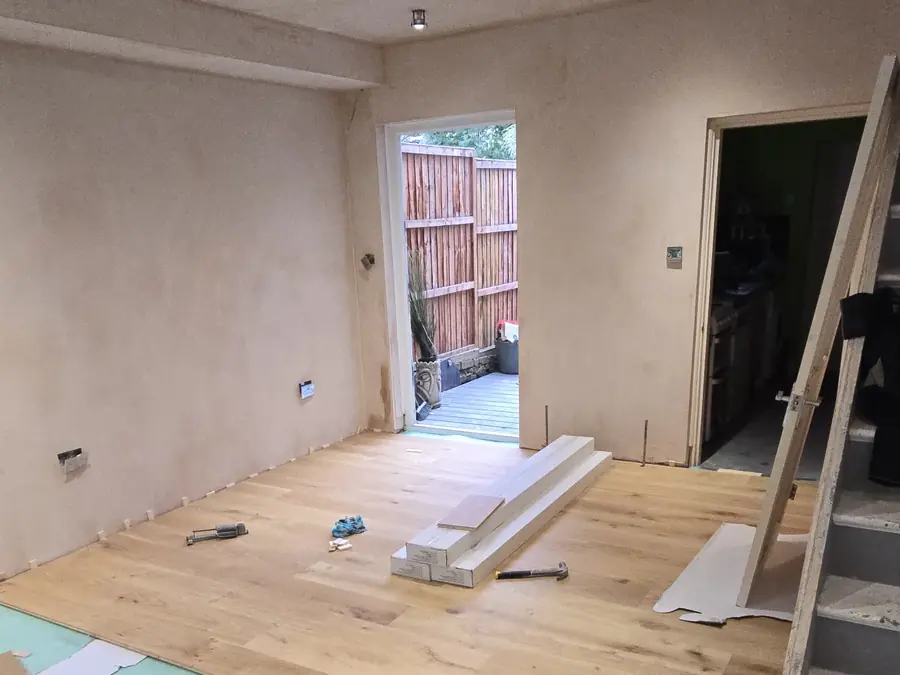
What an older Whitechapel terrace needs when the whole house is renewed
The pre-1919 houses in Whitechapel need repair in the materials they were built with. That means lime based plaster and mortar on solid brick walls rather than gypsum and cement, which trap damp in walls that were designed to breathe. Lath and plaster ceilings get assessed room by room: some can be pinned and skimmed, others have sagged too far and come down. Old lead or iron pipework and rubber or fabric insulated wiring come out as a matter of course once the floors are up.
A Whitechapel house refurbishment usually starts with opening up rather than building. Floorboards lift so joists can be checked for rot and old notching, the staircase is looked at for loose strings and worn treads. The sashes are surveyed to decide which can be overhauled with new cords and beads and which need new joinery. Only when the fabric is known do the first fix electrics and plumbing go in, so the price rests on what the house actually holds.
Housing in Whitechapel
The Council Tax list puts Whitechapel at about 9,330 homes, 92% flats against 8% houses; 19% went up before 1919, 8% between the wars and 72% after 1945. Since most homes here are flats, a whole house in Whitechapel is refurbished as one building, roof down.
Listed and conservation area rules on a Whitechapel house
Before a period house in Whitechapel is priced, its heritage position is checked. Altering a listed building in Tower Hamlets, inside or out, needs listed building consent, and that covers joinery, plaster and fireplaces as well as the front elevation. The owner or their designer arranges it, and we build to the consent. A house on the council's Local List is different: listed building consent is not needed, though the usual planning controls still apply to external changes.
Part of the area falls within the Whitechapel Market Conservation Area, designated in December 1997, extended in 2008 and amended in 2021. Tower Hamlets has 58 conservation areas, each with an adopted character appraisal and management guidelines, and those documents are what a Whitechapel owner reads before changing windows, doors or the roof. The management plan here says roof additions which seek to introduce a consistency in height are likely to be resisted. That is aimed at new storeys, but it shows what the council protects, so a roof renewal keeps the existing line and profile.
Street licences and noise hours for a Whitechapel house
A house refurbishment on a Whitechapel street is planned around the pavement outside. Tower Hamlets needs 7 working days notice to issue a skip licence, and each licence runs for between 1 and 28 days, with further applications needed for longer periods up to three months. A scaffold or hoarding on the highway for roof, gutter or chimney stack repairs needs a temporary structure licence applied for at least 10 working days before work is due to start.
Those lead times fix the start date, so the licence applications come first in a Whitechapel programme. Noisy work is permitted from 8am to 6pm Monday to Friday, with approval needed before any noisy work on Saturdays, Sundays or bank holidays, and Tower Hamlets controls construction noise under Sections 60 and 61 of the Control of Pollution Act 1974. The strip out, chasing and cutting therefore sit in weekday hours, with decoration and quieter second fix work later.
Phasing a Whitechapel house refurbishment and the building regulations
A Whitechapel house that stands empty can be refurbished in one continuous sequence: strip out, first fix, plaster, second fix and finish, floor by floor from the top down. A house the family lives in is phased instead, with one working bathroom and a kitchen kept going while other floors are done, which adds time but avoids moving out. We agree which approach suits before the programme is written, because it changes the order of every trade.
Some of the work is notifiable. Tower Hamlets building control charges for domestic work assume a Part P registered electrician, and a registered electrician certifies a full rewire. An engineer on the Gas Safe Register does the boiler and gas work. Where work falls under a building regulations application, a commencement notice goes to Tower Hamlets Council at least two working days before starting. Renewing a roof covering or relining an external wall in a Whitechapel terrace can also bring in Part L insulation for the renewed element.
- Staircase repairs: treads, risers, strings, balusters and newel posts
- Whole-house refurbishments for landlords re-letting a house
- Decoration throughout the house, woodwork and ceilings included
VOA Council Tax stock of properties, March 2025, for Whitechapel and Spitalfields. Counts rounded by the VOA.
Trusted House Refurbishment in Whitechapel
A Whitechapel terrace is tall, narrow and old, and refurbishing one well depends on doing things in the right order. We survey the fabric before pricing, apply the right materials to walls that need to breathe, and plan the skip and scaffold licences around the street. One team runs the strip out, first fix, plastering, joinery and decoration, and the founder has three decades of hands-on experience. A registered electrician certifies the rewire and an engineer on the Gas Safe Register handles gas heating work. The quotation is written after a visit.
- Empty and inherited houses secured and reported on while you are away
- Provisional sums for what lies behind the plaster shown as separate lines
- Dust screens and floor protection in occupied homes
George always kept to commitments and arrived on time. He offered helpful suggestions during his initial visit and promptly provided a reasonably…
We loved working with George and Ibrahim and would highly recommend them. They have done splendid job on our new kitchen refurb which including new…
Saaid is the best craftsman I have worked with. He knows what he is doing from the very beginning. He has a great knowledge of construction…
FAQ
Frequently Asked Questions about House Refurbishment Whitechapel
How much does a house refurbishment cost in Whitechapel?
Published UK figures put a three-bed house refurbishment at £43,530 to £110,350 (Checkatrade, 2026), and London houses usually cost more: a London architect allows £1,800 to £2,200 per square metre before VAT (Bradley Van Der Straeten Architects, 2026). For a Whitechapel house the survey decides where the job sits, from the wiring and pipework to the plaster, damp and roof. Each trade is then priced as its own line.
How many houses are there to refurbish in Whitechapel?
Few, in proportion. The valuation list count for the wider Whitechapel and Spitalfields area puts 8% of homes as houses and 92% as flats, and every house is terraced, with no semi-detached or detached houses. So a house refurbishment here means a terrace, with its own stairs, roof and party walls, and in the older streets a period house over several storeys.
What hours can noisy work run on a Whitechapel house?
From 8am to 6pm, Monday to Friday. Tower Hamlets needs approval before any noisy work on Saturdays, Sundays or bank holidays. On a house refurbishment that means the breaking out and chasing is packed into weekdays, while painting and similar quiet jobs can be planned for later in the programme.
How much notice does a skip outside a Whitechapel terrace need?
Seven working days. Tower Hamlets needs 7 working days notice to issue any skip licence, and a licence lasts between 1 and 28 days. Longer periods, up to three months, need further applications. On a street where a skip will not fit, bagged waste on regular collections is the alternative.
Does scaffolding for chimney repairs in Whitechapel need a licence?
Yes, when it stands on the highway. Tower Hamlets requires a temporary structure licence for scaffolding or hoarding, applied for at least 10 working days before work is due to start. That lead time goes into the programme before the start date is fixed. Scaffold standing wholly on private land needs no highway licence.
Does refurbishing a period house in Whitechapel need listed building consent?
Only if the house is listed. Altering a listed building in Tower Hamlets, internally or externally, needs listed building consent, which the owner arranges before work starts. A locally listed house does not need that consent, although the usual planning controls apply to changes on the outside.
Does a full rewire of a house need building control sign off?
A rewire is notifiable electrical work, and a registered electrician certifies and notifies it. Tower Hamlets building control charges for domestic work assume a Part P registered electrician, and a supplementary charge applies in other cases. Using a registered electrician keeps the paperwork simple when the house is later sold.
Why use lime plaster on solid brick walls rather than gypsum?
Because solid brick walls in period houses rely on moisture passing through them. Gypsum plaster and cement renders hold that moisture against the brick, which shows up as damp patches and blown plaster. Lime lets the wall dry out, so the repair lasts and the finish stays sound.
Can a family stay in the house during a refurbishment?
Yes, with phasing. The works are split so one bathroom and a basic kitchen stay usable, and each floor is sealed off while it is stripped and plastered. It takes longer than working in an empty house, and dusty stages such as the strip out are easier with the house empty for a week or two.
Every Service, One Team
More GS Renovation Services in Whitechapel
One team for every GS Renovation service in Whitechapel:
Same Service, Nearby Areas
House Refurbishment Near Whitechapel
We carry out house refurbishment across Whitechapel and the surrounding areas. Explore a nearby location:
Ready to Start Your Whitechapel Project?
Free, no-obligation quote for house refurbishment in Whitechapel.