House Refurbishment Bow
Whole-house refurbishments in Bow, every floor of the house renewed from the roof down, in the right order.
- Rated 4.9 from 31 reviews on MyBuilder
- UK guide: £43,530 to £110,350
- Free site survey, itemised quote
House refurbishment in Bow is work on a small part of the stock. Only 19% of homes in Bow are houses, 18% are terraced houses, and 23% of all homes were built before 1919, which puts the typical job in a terrace near Roman Road rather than a modern house. We renew the wiring, plumbing and heating, repair plaster, floors, joinery and windows, and decorate, keeping the plan of the house as it is and running the job to the Tower Hamlets street rules.
For Bow, published UK figures put a three-bed house refurbishment at £43,530 to £110,350, and London houses usually cost more, with a London architect allowing £1,800 to £2,200 per square metre before VAT (Checkatrade and Bradley Van Der Straeten Architects, 2026). GS Renovation Ltd, a building contractor based in Potters Bar, does the work in Bow: we renew the wiring, pipework, heating, plaster, floors and joinery of the whole house under one contract, and a registered electrician certifies the rewire.
Price guide
| Work | Indicative range |
|---|---|
| Three-bed house refurbishment, UK average | £43,530 to £110,350 |
| Non-structural house refurbishment in London, per square metre, excluding VAT | £1,800 to £2,200 per square metre |
| Full rewire, two-bed to five-bed house | £4,500 to £10,500 |
| New heating system, three-bed house | £3,000 to £8,500 |
| Re-skim walls and ceilings, three-bed house | £5,000 to £12,500 |
Indicative ranges from published cost guides (Checkatrade, Bradley Van Der Straeten Architects and MyJobQuote, 2026), not a quotation. Most are UK-wide figures and London work usually costs more; a row marked London is a London figure. Prices checked September 2026. Full breakdown: House Rewire Cost.
Quick estimate from UK guide figures
Guide range: choose above
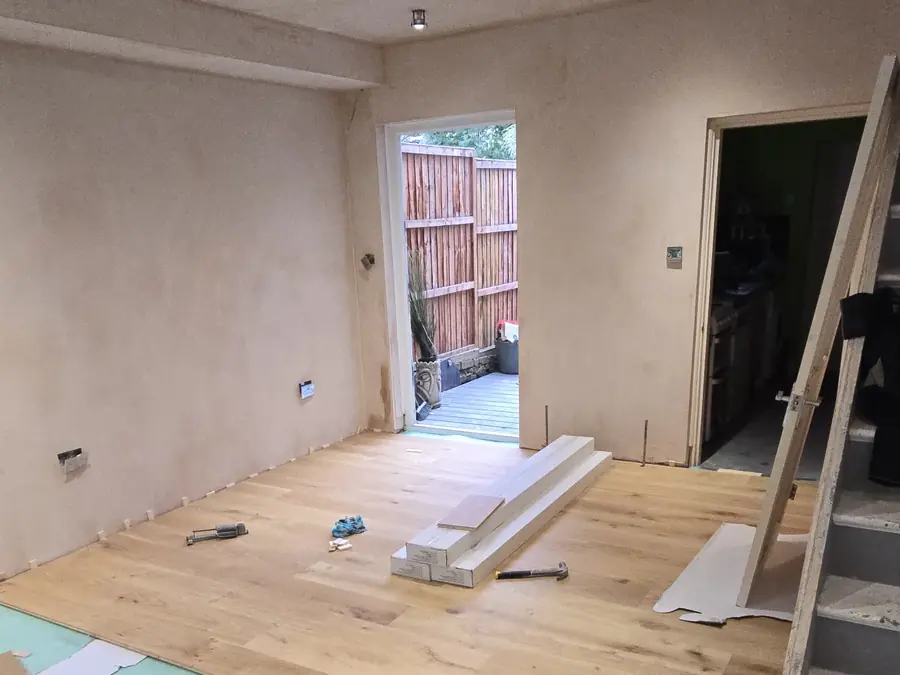
What a Victorian terrace in Bow hides behind the finishes
The older houses in Bow need repairs matched to their original materials before any new finish goes on. With 23% of homes in Bow built before 1919, a refurbishment here often meets lath and plaster ceilings, lime mortar and plaster on solid brick walls, suspended timber floors and lead or iron pipe runs that have been patched over decades. Gypsum plaster and cement render trap moisture in solid walls, so we repair like with like where the wall needs to breathe.
Opening up tells you the real scope, so we allow a stage for it at the start. Lifting boards and taking down a failed ceiling shows whether joists have been notched by earlier plumbers, whether the wiring is rubber insulated, and where damp is getting in. We then price the repair from what is found, before new wiring, pipework and plastering close everything up again. That order keeps you from paying twice for a wall that has to be reopened.
Housing in Bow
On the valuation list Bow counts about 15,000 homes, 81% flats and 19% houses; 23% predate 1919, 2% are interwar and 75% post-war. Since most homes here are flats, a whole house in Bow is refurbished as one building, roof down.
The order of works in a whole house refurbishment in Bow
A Bow house refurbishment runs in a fixed order: strip out, repairs, first fix, plaster, second fix, then decoration. First fix is the new cable runs, pipework and heating circuits laid in the open floors and walls. The registered electrician who does the rewire tests and certifies it, and Tower Hamlets Council's domestic building control charges assume a Part P registered electrician, with a supplementary charge where one is not used. A registered gas engineer connects and commissions any new boiler.
Where the refurbishment touches the structure of a house in Bow, such as a rotten joist end, a failed lintel or a stair that needs rebuilding, building regulations approval is needed. Tower Hamlets Council says so for alterations to the structure, and a commencement notice goes to the council at least two working days before that work starts. Insulation added to a renewed roof, wall or floor has to meet Part L, so the specification for those elements is fixed before the materials are ordered.
Noise hours, skips and scaffolding outside a Bow house
A terraced street in Bow has neighbours on both sides, so the noisy stages are booked into the hours the council allows. Tower Hamlets permits noisy construction work from 8am to 6pm, Monday to Friday, and noisy work on a Saturday, Sunday or bank holiday needs approval first. The council controls construction noise under Section 60 and Section 61 of the Control of Pollution Act 1974. Chasing walls, breaking out old hearths and cutting boards all happen on weekdays.
A skip or scaffold on the road needs a licence, and the lead times shape the start date. Tower Hamlets needs 7 working days notice to issue a skip licence, which can run for between 1 and 28 days before a further application is needed. A temporary structure licence for scaffolding or hoarding has to be applied for at least 10 working days before work is due to start. That matters on a Bow terrace where a chimney stack, gutter or front slope needs work at height.
Conservation areas and listed houses in Bow
Before windows, doors or the roof covering of a Bow house are renewed, check whether it sits in a conservation area. Tower Hamlets has 58 conservation areas, each with an adopted character appraisal and management guidelines, and the council's appraisal says the Tredegar Square Conservation Area straddles Mile End and Bow. Those guidelines are the place to read what the council says about original sashes, front doors and slate roofs before a replacement is ordered. Where a sash can be repaired, that keeps the original frame and avoids a replacement decision altogether.
A listed house in Bow needs listed building consent for alterations inside or out, and Tower Hamlets has around 2,000 Grade II listed buildings. Stripping original plaster, joinery or a fireplace in one is treated as an alteration, so the consent is in place before strip out, and the owner or their designer applies for it. A house on the Local List is different: works to it need no listed building consent, though the usual planning controls still apply.
- Whole-house rewires, certified at completion by a registered electrician
- Sash boxes overhauled with new cords, parting beads and brush seals
- Part L insulation where outside walls, floors or roofs are renovated
VOA Council Tax stock of properties, March 2025, for Bow North & Fish Island, Bow West and Bow South. Counts rounded by the VOA.
Why Bow Homeowners Choose GS Renovation
A house refurbishment runs through many trades, and the risk is in the gaps between them. We manage the sequence from strip out to decoration, so the plasterer is not waiting on the electrician and nothing is closed up before it has been checked. You get a written scope after opening up, a programme that fits whether you are living in the house or it is empty, and one person to call. Electrical certification and gas work are done by registered engineers within our programme and handed over with the paperwork.
- Damp traced to its source before anyone suggests an injected course
- Waste cleared as we go, not left piled up outside
- First fix cabling on each floor inspected by the electrician before the walls are closed
George always kept to commitments and arrived on time. He offered helpful suggestions during his initial visit and promptly provided a reasonably…
We loved working with George and Ibrahim and would highly recommend them. They have done splendid job on our new kitchen refurb which including new…
Saaid is the best craftsman I have worked with. He knows what he is doing from the very beginning. He has a great knowledge of construction…
FAQ
Frequently Asked Questions about House Refurbishment Bow
What should I budget for a full house refurbishment in Bow?
Start from the published UK range of £43,530 to £110,350 for a three-bed house (Checkatrade, 2026) and expect a London house to sit higher. Add a contingency for what only shows once plaster and floors are opened. The itemised quote after the Bow survey shows each trade separately, so the work can be phased if the total is more than you want to spend at once.
What will a refurbishment of a Victorian terrace in Bow uncover?
Usually some mix of lath and plaster ceilings, lime plastered solid walls, old wiring and lead or iron pipework. 23% of homes in Bow were built before 1919, and those houses have had a century of repairs of varying quality. We open up first, then fix the scope and price from what is actually there.
Is house refurbishment common work in Bow, given how many homes are flats?
It is the smaller share of the work here. 19% of homes in Bow are houses and 81% are flats, and 18% are terraced houses, so a whole house job is usually a terrace. The houses that come up tend to be older and need their services renewed together, which is where a single managed programme helps.
Does a rewire of a house in Bow need a building control application?
Not where a registered electrician certifies it. Tower Hamlets Council's domestic building control charges assume a Part P registered electrician, and a supplementary charge applies in other cases. The electrician tests the new circuits and issues the certificate, which you keep with the house deeds and hand to a buyer's solicitor later.
What hours can builders make noise on a street in Bow?
Noisy construction work is permitted from 8am to 6pm, Monday to Friday. Noisy work on Saturdays, Sundays or bank holidays needs approval from Tower Hamlets Council before it happens. We keep weekend days for quiet tasks or leave them free, and tell the neighbours on both sides when the loud stages start.
How much notice is needed for a skip outside a house in Bow?
Tower Hamlets needs 7 working days notice to issue a skip licence. The licence can run for between 1 and 28 days, and a longer job needs further applications, up to three months. A skip on your own land needs no licence. We book it once the start date is fixed, so it arrives on the day strip out begins.
Can the sash windows of a house in the Tredegar Square Conservation Area be replaced?
Possibly, but read the council's guidance for the area before ordering anything. Each of the 58 conservation areas in Tower Hamlets has an adopted character appraisal and management guidelines, and the Tredegar Square Conservation Area straddles Mile End and Bow. The owner or their designer checks with the council whether a replacement needs consent. Repairing the existing sashes, with new cords, beads and draught seals, keeps the original frames.
How do you prepare a probate or pre-sale house for market?
We start with a walk round to separate what a buyer's surveyor will flag from what is cosmetic. Safety items such as wiring and gas come first, then damp, roof and plaster repairs, then decoration and flooring. Keeping the scope to that order stops money going on finishes that a survey would undo, and an empty house can be done in one run.
Can we live in the house during a refurbishment?
Often, if the work is phased floor by floor and one bathroom stays working. A full rewire or replumb is easier with the house empty, because power and water go off for periods. We agree the phasing before we start, keep a clean route through the house each evening, and seal off the rooms being stripped.
Every Service, One Team
More GS Renovation Services in Bow
One team for every GS Renovation service in Bow:
Same Service, Nearby Areas
House Refurbishment Near Bow
We carry out house refurbishment across Bow and the surrounding areas. Explore a nearby location:
Ready to Start Your Bow Project?
Free, no-obligation quote for house refurbishment in Bow.