House Refurbishment Islington
Whole-house refurbishments in Islington, every floor of the house renewed from the roof down, in the right order.
- Rated 4.9 from 31 reviews on MyBuilder
- UK guide: £43,530 to £110,350
- Free site survey, itemised quote
Only 15% of Islington homes are houses, almost all of them terraces, and 43% of all homes predate 1919, on VOA figures for the borough. So a whole house job here is most likely a terrace, and in the older streets that means a Georgian or Victorian house that needs its wiring, pipes, plaster, floors and sashes renewed as one programme. We renew the fabric of the whole house without re-planning it, and plan the street licences from the first visit.
For Islington, published UK figures put a three-bed house refurbishment at £43,530 to £110,350, and London houses usually cost more, with a London architect allowing £1,800 to £2,200 per square metre before VAT (Checkatrade and Bradley Van Der Straeten Architects, 2026). GS Renovation Ltd, a building contractor based in Potters Bar, does the work in Islington: we renew the wiring, pipework, heating, plaster, floors and joinery of the whole house under one contract, and a registered electrician certifies the rewire.
Price guide
| Work | Indicative range |
|---|---|
| Three-bed house refurbishment, UK average | £43,530 to £110,350 |
| Non-structural house refurbishment in London, per square metre, excluding VAT | £1,800 to £2,200 per square metre |
| Full rewire, two-bed to five-bed house | £4,500 to £10,500 |
| New heating system, three-bed house | £3,000 to £8,500 |
| Re-skim walls and ceilings, three-bed house | £5,000 to £12,500 |
Indicative ranges from published cost guides (Checkatrade, Bradley Van Der Straeten Architects and MyJobQuote, 2026), not a quotation. Most are UK-wide figures and London work usually costs more; a row marked London is a London figure. Prices checked September 2026. Full breakdown: House Rewire Cost.
Quick estimate from UK guide figures
Guide range: choose above
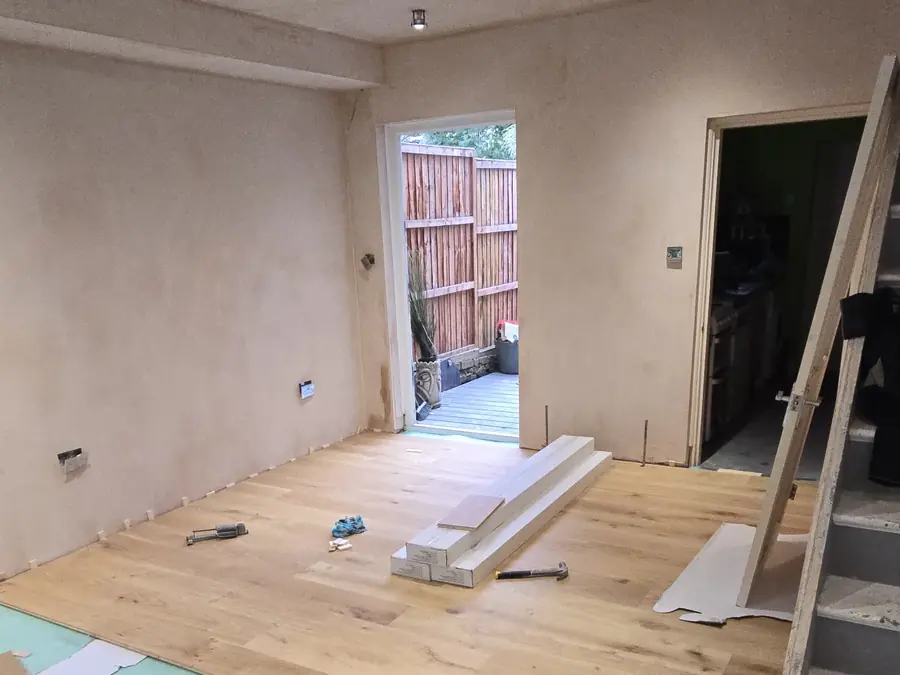
The Islington terrace and the fabric a refurbishment finds
A house refurbishment in Islington is usually a terrace, and its age sets the scope. In a house built before 1919 you can find lath and plaster ceilings and lime mortar and plaster, which should be repaired with lime rather than patched in gypsum. There are suspended timber floors too, and a history of wiring and pipework added a decade at a time. We open up a sample of walls and floors before pricing, because what sits behind the plaster sets the scope more than the finishes you choose.
Only 4% of Islington homes date from between the wars, so an interwar house here is unusual. In the older terraces the joists often carry notches cut for earlier pipe runs, stairs have loosened at the strings, and chimney stacks, parapet gutters and valley roofs have had decades of patch repair. Rebuilding, cutting into or substantially repairing a stack on the party wall can need a party wall notice, which the building owner serves; routine repointing or new flashings usually do not. We record those defects room by room at survey stage, so the roof, gutter and stack repairs come before any new ceiling goes up. Renewing a roof covering or replastering an outside wall can also bring in Part L insulation, which we price with the fabric.
Housing in Islington
Islington has around 112,190 homes on the Council Tax list: 50% post-war, 4% interwar and 43% predate 1919, with 85% flats and 15% houses. Where most homes in Islington are flats, a whole house is refurbished as one building, with a single intake for the services and one roof to keep sound, which matters here because most homes are flats.
Windows, doors and front elevations under Islington's Article 4 directions
Islington Council states there are 42 conservation areas in the borough, and it has removed permitted development rights in 40 of them with an Article 4 direction. For a house refurbishment, that matters at the front. Islington says a house covered by an Article 4 direction needs householder planning permission to install or replace windows or doors on the front of the house. Painting the outside brickwork can need permission too, so a refurbishment that plans to refresh the facade has a consent question before it has a colour.
The practical answer in an Islington terrace is often repair rather than replacement. Original sashes can be taken out, the rotten sections spliced with new timber, the cords and weights renewed and the beads draught stripped, which keeps the look of the front while improving comfort. Panelled front doors can be eased, repaired and refinished the same way. If you do want new windows, you or your designer seek the permission first, and we order the joinery to the approved drawings.
Getting skips, scaffold and vans to an Islington house
A whole house refurbishment in Islington creates a steady stream of waste and deliveries, and the street is controlled. Islington requires a licence for any temporary obstruction on the public highway, including scaffolding, gantries, hoardings and building materials. The skip licence is charged by the calendar month, so a long strip out and a slow reinstatement both show up in the running costs. We plan the skip weeks around the heavy stages and switch to bagged waste collections for the finishing weeks.
Scaffold for roof, stack and gutter repairs needs its own lead time: Islington asks for scaffolding and gantry licence applications at least 10 working days ahead. A house on a red route such as Holloway Road, Upper Street or City Road also needs Transport for London's permission for anything on the road. Near the Emirates Stadium, skips must be gone at least seven hours before a match or event. We set the start date after those approvals, not before them.
Living in or moving out during an Islington house refurbishment
Whether you stay in the house decides the Islington programme more than any other choice. An empty house can be stripped in one go, then first fixed, plastered, second fixed and finished floor by floor in a straight run. If you live in, we phase the work: one floor at a time, a temporary kitchen, a working bathroom kept until the new one is usable, and dust screens at the stairs. Phasing lengthens the programme, so we show both versions before you decide.
The hours for loud work also shape the day. Islington restricts noisy building work to between 8am and 6pm on weekdays and 8am until 1pm on Saturdays, unless the council gives prior approval, and a terrace shares its party walls with neighbours on both sides. We keep breaking out, chasing and floor lifting inside those hours and tell the neighbours when the loudest weeks fall. Quieter trades such as decorating and joinery fill the rest of the programme.
- Whole-house rewires, certified at completion by a registered electrician
- Lime plastering on solid walls and lath and plaster ceiling repairs
- New boiler, cylinder and radiators sized to every room, fitted by a Gas Safe registered engineer
VOA Council Tax stock of properties, March 2025, for all 23 statistical areas in Islington. Counts rounded by the VOA.
Trusted House Refurbishment in Islington
A house refurbishment runs in a strict order: survey and opening up, roof and external repairs, strip out, first fix services, plastering, second fix, joinery and decoration. We manage that order with our own team and the trades we bring in, and give you one programme and a written quotation after a site visit. A registered electrician certifies the rewire, and gas work on the new boiler is done by a registered gas engineer. You get the certificates, and building control sign-off where it applies, at handover.
- Roof, gutters and chimney stacks looked at before the top-floor plaster is priced
- A top-floor-first programme when your family stays in the house
- Dust screens and floor protection in occupied homes
Reviewed jobs near Islington
1 MyBuilder review from Islington, with each customer's own job title:
- Kitchen refit in ex-local authority maisonette, Islington, 8 Jul 2022 (5 out of 5)
Read all 31 on our reviews page.
George always kept to commitments and arrived on time. He offered helpful suggestions during his initial visit and promptly provided a reasonably…
We loved working with George and Ibrahim and would highly recommend them. They have done splendid job on our new kitchen refurb which including new…
Saaid is the best craftsman I have worked with. He knows what he is doing from the very beginning. He has a great knowledge of construction…
FAQ
Frequently Asked Questions about House Refurbishment Islington
How much does a house refurbishment cost in Islington?
Published UK figures put a three-bed house refurbishment at £43,530 to £110,350 (Checkatrade, 2026), and London houses usually cost more: a London architect allows £1,800 to £2,200 per square metre before VAT (Bradley Van Der Straeten Architects, 2026). For a Islington house the survey decides where the job sits, from the wiring and pipework to the plaster, damp and roof. Each trade is then priced as its own line.
Is house refurbishment common in Islington, given how many homes are flats?
Less common than flat work. The VOA figures show 85% of Islington homes are flats and 15% are houses, and almost all of those houses are terraces, so a whole house job here is nearly always a terrace. With 43% of all homes built before 1919, the older terraces are the ones that tend to need services and fabric renewed together.
Is permission needed to replace the front windows of an Islington house?
If the house is in one of Islington's Article 4 conservation areas, yes. Islington Council says a house covered by an Article 4 direction needs householder planning permission to install or replace windows or doors on the front of the house. Repairing the existing sashes like for like is not a replacement, so it does not normally need that application. In a listed house, though, even like-for-like repair can need listed building consent where it affects the building's character. You or your designer apply for any permission, and we build to it.
Can a listed Islington house be refurbished?
Yes, with listed building consent for works that affect its character, inside as well as out, which the owner or their designer obtains before work starts. Islington Council says the borough has around 4,500 listed buildings. A locally listed house is different: the council says listed building consent is not needed for works to it, though the usual planning controls still apply. Check the status of the address before fixing the scope, because it changes what can be replaced and what must be repaired.
How long does a full house rewire and replastering take?
The length is set by the number of floors, whether you live in, and the plaster. Services are first fixed into open walls and inspected, then the walls are plastered and left to dry before second fix. Lime plaster dries far more slowly than gypsum, so in an older terrace its drying time is built into the programme. After the survey we give you the dates floor by floor, for an empty house and for a phased one.
Must the council be told about tree work during an Islington house refurbishment?
If the house is in a conservation area and a tree needs pruning or felling for scaffold or access, yes. Islington requires six weeks notice in writing before work to prune or fell a tree in a conservation area, and nationally that applies to trees with a trunk over 75 millimetres in diameter at 1.5 metres above the ground. Give that notice early, because scaffold dates for roof and stack repairs often depend on it.
Can the brick front of an Islington house be painted during a refurbishment?
Check first. In Islington's Article 4 conservation areas you may need planning permission for minor alterations such as painting brickwork on the outside of a property. Painting brick can also trap moisture in a pre-1919 wall. Cleaning and repointing in lime, where the mortar has failed, is usually the better refurbishment of a front elevation.
Does renewing the roof or walls of an Islington house bring in insulation rules?
It can. When a roof covering is renewed or an outside wall is replastered over a large area, Part L of the Building Regulations can require that element to be insulated where it is practical. In a solid walled Islington terrace built before 1919, the insulation has to let lime walls breathe, so we agree the detail with building control before plastering.
Can you refurbish a house for sale or after probate?
Yes, and the scope is usually narrower than a full renewal. For a sale we deal with the defects a buyer's surveyor will find, safe electrics and heating, and clean neutral finishes. For a probate house we clear, make safe and repair first, then agree the finish level with the executors. One programme and one written quotation help you plan around the sale date.
Every Service, One Team
More GS Renovation Services in Islington
One team for every GS Renovation service in Islington:
Same Service, Nearby Areas
House Refurbishment Near Islington
We carry out house refurbishment across Islington and the surrounding areas. Explore a nearby location:
Ready to Start Your Islington Project?
Free, no-obligation quote for house refurbishment in Islington.