House Refurbishment Notting Hill
Whole-house refurbishments in Notting Hill, every floor of the house renewed from the roof down, in the right order.
- Rated 4.9 from 31 reviews on MyBuilder
- UK guide: £43,530 to £110,350
- Free site survey, itemised quote
Only 24% of homes in Notting Hill are houses, the VOA list shows, almost all of them terraces, and 75% of all homes were built before 1919. A whole house here is most likely a stucco or brick terrace with lime plaster, lath ceilings, sash windows and services that have been patched for decades. We renew that fabric floor by floor without re-planning the house, and keep the street and the neighbours informed.
For Notting Hill, published UK figures put a three-bed house refurbishment at £43,530 to £110,350, and London houses usually cost more, with a London architect allowing £1,800 to £2,200 per square metre before VAT (Checkatrade and Bradley Van Der Straeten Architects, 2026). GS Renovation Ltd, a building contractor based in Potters Bar, does the work in Notting Hill: we renew the wiring, pipework, heating, plaster, floors and joinery of the whole house under one contract, and a registered electrician certifies the rewire.
Price guide
| Work | Indicative range |
|---|---|
| Three-bed house refurbishment, UK average | £43,530 to £110,350 |
| Non-structural house refurbishment in London, per square metre, excluding VAT | £1,800 to £2,200 per square metre |
| Full rewire, two-bed to five-bed house | £4,500 to £10,500 |
| New heating system, three-bed house | £3,000 to £8,500 |
| Re-skim walls and ceilings, three-bed house | £5,000 to £12,500 |
Indicative ranges from published cost guides (Checkatrade, Bradley Van Der Straeten Architects and MyJobQuote, 2026), not a quotation. Most are UK-wide figures and London work usually costs more; a row marked London is a London figure. Prices checked September 2026. Full breakdown: House Rewire Cost.
Quick estimate from UK guide figures
Guide range: choose above
What a pre-1919 Notting Hill interior hides behind the paint
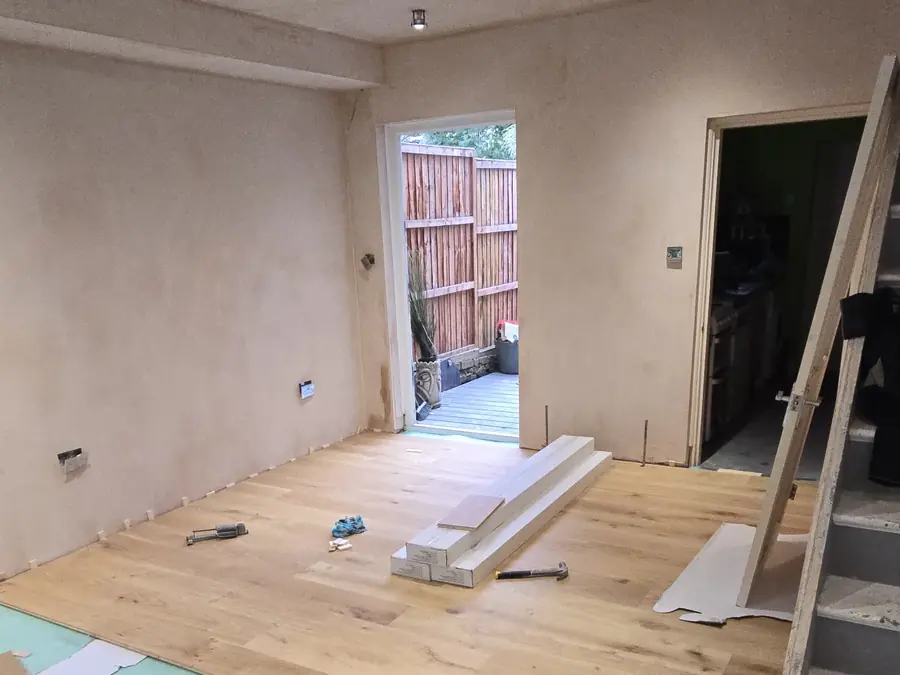
Expect a pre-1919 Notting Hill interior to have lime plaster on the brick walls and lath and plaster on the ceilings and stud partitions, with a century of alterations layered on top. With 75% of homes here built before 1919, this is the normal starting point rather than a surprise. Once the finishes come off, you often find cut joists from earlier plumbing runs, rubber insulated or lead sheathed cable, and hairline cracks that follow old openings. Budget time for opening up and a pause to decide what stays.
In a whole terrace house the order runs from the top down and the bottom up at once. The roof, gutters and chimney stacks are checked first, because water getting in undoes everything below. Then comes the strip, the survey of joists and walls, first fix of wiring and pipework while floors are up, plastering, second fix and decoration. Lime plaster is patched in lime where the wall needs to breathe, and a registered electrician tests and certifies the new circuits before any wall is closed.
Housing in Notting Hill
Notting Hill counts roughly 12,530 homes for Council Tax; 75% are older than 1919, 7% interwar and 17% post-war, with 76% flats and 24% houses. Most homes here are flats, and where most homes in Notting Hill are flats, a whole house is refurbished as one building, with a single intake for the services and one roof to keep sound.
Conservation areas, windows and roofs on a Notting Hill house
Conservation area status shapes what a Notting Hill house refurbishment can change outside. The council's plan states that conservation areas cover more than 73 per cent of the borough, and the Ladbroke Conservation Area, designated in 1969, has its centre at the peak of Notting Hill. Inside a conservation area, like-for-like repair of the front elevation, the roof and the railings is the safe default. Anything that alters the look of the house needs checking with the council first.
Windows are where this bites most. The council's Householders' Guide to windows states that building regulations apply to all replacement windows, so a new sash has to meet current thermal and safety rules even when it copies the old one. The borough has also consulted on a Windows Local Development Order to remove separate planning permission for changing windows in non-listed homes. If the house is one of the borough's over 4,000 listed buildings, you or your designer obtain listed building consent first, and it covers the interior as well as the front.
Working hours and noisy stages on a Notting Hill street
Noisy work on a Notting Hill house runs to the Royal Borough's construction code, not to the builder's preference. The council's Final Draft Code of Construction Practice sets permitted hours for noisy work audible at the site boundary of 8am to 6pm Monday to Friday, with none at weekends or on public holidays. High impact activities, including all demolition and concrete breaking, are limited further to 9am to noon and 2pm to 5:30pm on weekdays.
That changes how a whole-house strip is programmed. Hacking off failed plaster, lifting screeds and breaking out old hearths are grouped into the permitted high impact windows, and quieter tasks such as first fix, joinery and decoration fill the rest of the day. On a terrace the party walls carry sound straight into the houses either side, so we tell the neighbours which days are loud. Saturday working on noisy stages is not an option to plan around.
Scaffold licences, skips and bay suspensions for a W11 house
A refurbishment that needs scaffolding at the front of a Notting Hill house needs a licence from the council before it goes up. Scaffolding, hoarding, gantries and mobile towers on the public highway each need a temporary structure licence, and no work on the highway may start until the council has given written approval. Roof, stack and stucco repairs on the front elevation all depend on that licence, so it goes at the head of the programme. Repairing a chimney stack shared with the next house needs a party wall notice under the Party Wall Act: the owner serves notice, and that repair waits for written consent or an award.
For skips and deliveries, the Royal Borough suspends parking bays for building works where the trades arrive in vans rather than cars. A whole-house strip fills several skips, and in many W11 streets a suspended bay is the only place one can stand. Where a larger job has an agreed Construction Traffic Management Plan, the council's Construction Management Team deals with suspensions and licences and only issues those agreed in the plan. We book the bays around the strip-out weeks.
- Pre-sale and probate refurbishments of empty houses
- Sash boxes overhauled with new cords, parting beads and brush seals
- Staircase repairs: treads, risers, strings, balusters and newel posts
VOA Council Tax stock of properties, March 2025, for Notting Hill Gate, Notting Hill West and Notting Hill South. Counts rounded by the VOA.
Why Choose GS Renovation in Notting Hill
A whole house is renewed trade by trade, and each trade depends on the one before. We run the strip, first fix, plastering, second fix and decoration as one programme under one contact, so nobody waits on anybody else. We plan the loud stages into the permitted hours, make sure the scaffold licence is approved and the bays are suspended before work starts, and hand over the electrical and gas certificates and building control sign off at the end.
- First fix cabling on each floor inspected by the electrician before the walls are closed
- Asbestos sampling arranged before textured ceilings or old floor tiles are disturbed
- Itemised pricing, so you can see what every stage costs
George always kept to commitments and arrived on time. He offered helpful suggestions during his initial visit and promptly provided a reasonably…
We loved working with George and Ibrahim and would highly recommend them. They have done splendid job on our new kitchen refurb which including new…
It's the second time I have hired George and he has been absolutely professional and the work he did resembles perfectly what I had in mind. Being an…
FAQ
Frequently Asked Questions about House Refurbishment Notting Hill
What should I budget for a full house refurbishment in Notting Hill?
Start from the published UK range of £43,530 to £110,350 for a three-bed house (Checkatrade, 2026) and expect a London house to sit higher. Add a contingency for what only shows once plaster and floors are opened. The itemised quote after the Notting Hill survey shows each trade separately, so the work can be phased if the total is more than you want to spend at once.
What does old lath and plaster mean for refurbishing a Notting Hill house?
It means allowing time to open up and assess before the scope is fixed. With 75% of homes here built before 1919, ceilings are commonly lath and lime plaster and walls are lime plastered brick. Sound areas can be repaired in lime, while failed ceilings are replaced in board and skim before any cornice work.
What hours can noisy refurbishment work run on a Notting Hill house?
Under the council's Final Draft Code of Construction Practice, noisy work audible at the boundary runs 8am to 6pm Monday to Friday, with none at weekends or on public holidays. Demolition and concrete breaking are limited to 9am to noon and 2pm to 5:30pm on weekdays, so the strip-out is planned into those slots.
Is a licence needed for scaffolding outside a Notting Hill house?
Yes. Scaffolding, hoarding, gantries and mobile towers on the public highway each need a temporary structure licence from the council, and no highway work may start until the licence is approved in writing. Front elevation, roof and chimney stack repairs all wait on it, so apply early in the programme.
Do replacement sash windows on a Notting Hill house need building regulations approval?
Yes. The council's Householders' Guide to windows states that building regulations apply to all replacement windows, so a new sash must meet current thermal and safety standards even when it copies the original. An installer registered with a competent person scheme, or a building control application, shows compliance. Overhauling the existing sashes avoids that route.
Is a Notting Hill house likely to sit in a conservation area?
Quite possibly. The council states that conservation areas cover more than 73 per cent of the borough, and the Ladbroke Conservation Area has its centre at the peak of Notting Hill. Check the council's map for your address before changing windows, doors, roof coverings or railings, and plan like-for-like repair where you can.
Can you refurbish a house for sale or probate in Notting Hill?
Yes. A pre-sale or probate refurbishment is usually a focused scope: making good, redecoration, electrical and heating checks, and repairs a buyer's surveyor would flag. We agree the scope and programme with the executors or seller, and leave the house clean and ready for photographs and viewings.
Should we live in the house during a whole-house refurbishment?
Only if the work can be phased. An empty house lets every trade work every floor in sequence, which is quicker and cleaner. If you stay, we split the house into zones, keep one bathroom and a kitchen area working, and seal each zone against dust. Rewiring and replumbing still need short periods with services off.
Who certifies the electrics and gas on a house refurbishment?
A registered electrician tests and certifies the new circuits, and an engineer on the Gas Safe Register carries out and certifies any gas work, including a new boiler. We schedule both inside the programme and hand you the certificates at completion, with building control sign off where the work needs it.
Every Service, One Team
More GS Renovation Services in Notting Hill
One team for every GS Renovation service in Notting Hill:
Same Service, Nearby Areas
House Refurbishment Near Notting Hill
We carry out house refurbishment across Notting Hill and the surrounding areas. Explore a nearby location:
Ready to Start Your Notting Hill Project?
Free, no-obligation quote for house refurbishment in Notting Hill.