House Refurbishment Chelsea
Whole-house refurbishments in Chelsea, every floor of the house renewed from the roof down, in the right order.
- Rated 4.9 from 31 reviews on MyBuilder
- UK guide: £43,530 to £110,350
- Free site survey, itemised quote
House refurbishment in Chelsea is a job for a smaller part of the stock than people expect. The VOA list puts houses at 21% of homes here, almost all of them terraces, and 57% of all homes were built before 1919. The typical brief is a Georgian or Victorian terrace between the King's Road and Fulham Road that needs new wiring, pipework, heating, plaster and joinery without moving walls. It sits on a street where scaffold, parking bays and noisy hours are all regulated.
For Chelsea, published UK figures put a three-bed house refurbishment at £43,530 to £110,350, and London houses usually cost more, with a London architect allowing £1,800 to £2,200 per square metre before VAT (Checkatrade and Bradley Van Der Straeten Architects, 2026). GS Renovation Ltd, a building contractor based in Potters Bar, does the work in Chelsea: we renew the wiring, pipework, heating, plaster, floors and joinery of the whole house under one contract, and a registered electrician certifies the rewire.
Price guide
| Work | Indicative range |
|---|---|
| Three-bed house refurbishment, UK average | £43,530 to £110,350 |
| Non-structural house refurbishment in London, per square metre, excluding VAT | £1,800 to £2,200 per square metre |
| Full rewire, two-bed to five-bed house | £4,500 to £10,500 |
| New heating system, three-bed house | £3,000 to £8,500 |
| Re-skim walls and ceilings, three-bed house | £5,000 to £12,500 |
Indicative ranges from published cost guides (Checkatrade, Bradley Van Der Straeten Architects and MyJobQuote, 2026), not a quotation. Most are UK-wide figures and London work usually costs more; a row marked London is a London figure. Prices checked September 2026. Full breakdown: House Rewire Cost.
Quick estimate from UK guide figures
Guide range: choose above
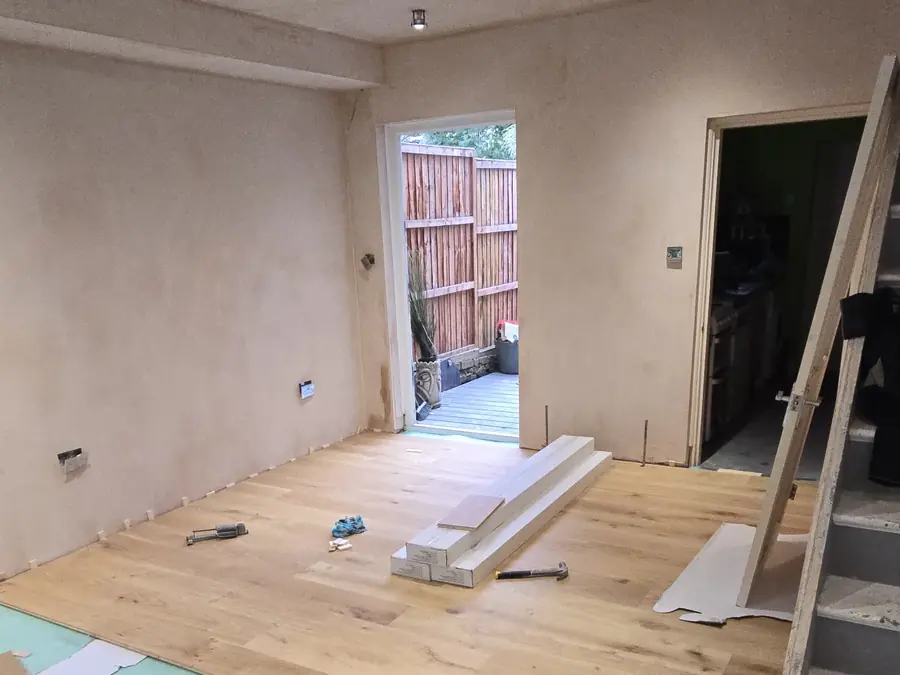
What a pre-1919 Chelsea terrace hides behind the plaster
A Chelsea terrace built before 1919 usually carries a century of piecemeal repairs, and the refurbishment starts by finding them. With 57% of homes here predating 1919 and a further 11% from the interwar years, expect lath and plaster ceilings, lime-based wall plaster, boarded floors over timber joists, and cables and pipes that have been added to rather than replaced. Old lead supply pipe, iron gas pipe and rubber-insulated wiring all turn up in houses of this age.
We lift boards, open small holes in ceilings and check behind skirtings before the price is fixed. That tells you whether joists have been notched too deeply by earlier plumbers, where damp has reached timber, and whether a wall can be patched in lime or needs taking back. The survey drawings then carry the real condition of the house, so the programme and quote are built on it rather than on a guess about what a Chelsea house of this age ought to contain.
Housing in Chelsea
The Council Tax list puts Chelsea at about 12,410 homes, 79% flats against 21% houses; 57% went up before 1919, 11% between the wars and 31% after 1945. Since most homes here are flats, where most homes in Chelsea are flats, a whole house is refurbished as one building, with a single intake for the services and one roof to keep sound.
Rewire, replumb and heating in a whole Chelsea house
Renewing the services is usually the backbone of a Chelsea house refurbishment, because every other trade waits for first fix. The order is strip out, then first fix electrics, plumbing and heating pipework while floors and walls are open, then plaster, then second fix and decoration. A registered electrician tests and certifies the new installation, and a registered gas engineer installs and commissions any gas boiler or hob. We run those trades inside one programme so the floors are lifted once.
A tall terrace brings its own decisions. The heating has to reach four or five storeys evenly, the hot water has to travel from the plant to a top floor bathroom, and the new consumer unit needs a sensible home that is not in a damp lower ground room. Where pipework crosses joists, we route it to avoid weakening them. If you are living in the house, we phase the work floor by floor and keep one bathroom and a working kitchen running for as long as the sequence allows.
Sash windows, roofs and the Chelsea Conservation Area
A Chelsea terrace may well sit inside a conservation area, so check the designation before any work to the outside of the house. The Chelsea Conservation Area was designated in 1983, joining the former St Luke's, Markham and Milner areas, and it covers groups of modest terraces between Fulham Road and the King's Road. Across the borough, conservation areas cover more than 73 per cent of the land. Repairing sash windows, slate roofs and chimney stacks like for like keeps the job simple, and any change of design is where consent questions start. A stack shared with next door is different: repairing or rebuilding it needs a party wall notice under the Party Wall Act, and you as building owner serve the notice.
On windows, the council has consulted on a Windows Local Development Order that would remove the need for separate planning permission to change existing windows in non-listed homes across the borough, so check whether it has been made before you order. Building regulations apply to all replacement windows either way. Where the house is listed, and the borough has over 4,000 listed buildings, the owner or their designer applies for listed building consent first, covering work inside the house as well as outside, and we build to it.
Scaffold licences, van bays and working hours on a Chelsea street
A Chelsea house refurbishment that needs a front scaffold cannot start on the pavement until the council says so. Scaffolding, hoarding and mobile towers on the public highway each need a temporary structure licence, and no work on the highway may begin until the council has approved the licence in writing. We put that approval ahead of the roof and front elevation repairs in the programme, and the skip hire firm arranges the permit for a skip in the road.
Vans are the other issue on a residential street. The council suspends parking bays for building or maintenance works where tradespeople arrive in vans, not cars, so we book the days we need. Its Final Draft Code of Construction Practice sets noisy work audible at the boundary to 8am to 6pm on weekdays, none at weekends, and limits high impact work such as demolition and breaking out to 9am to noon and 2pm to 5:30pm. We schedule the strip out inside those windows.
- Replacement windows to Approved Document L where sashes are beyond repair
- Lime plastering on solid walls and lath and plaster ceiling repairs
- Pre-sale and probate refurbishments of empty houses
VOA Council Tax stock of properties, March 2025, for Chelsea Manor & Royal Hospital, Chelsea Riverside East and Chelsea Riverside West. Counts rounded by the VOA.
Why Choose GS Renovation in Chelsea
We take on a whole Chelsea house as one contract: strip out, services, plaster, joinery, repairs and decoration in a single sequence. Our founder, Abdelaaziz Saaid, has more than three decades of hands-on building work behind him. After a site visit and some opening up you get a fixed quote and a written programme showing when each floor is out of use. A registered electrician certifies the wiring, a registered gas engineer does the gas work, and we book the building control inspections.
- Asbestos sampling arranged before textured ceilings or old floor tiles are disturbed
- Neighbours given notice before the noisy stages
- Radiators, sockets and switches positioned at first fix, never after decorating
George always kept to commitments and arrived on time. He offered helpful suggestions during his initial visit and promptly provided a reasonably…
We loved working with George and Ibrahim and would highly recommend them. They have done splendid job on our new kitchen refurb which including new…
Saaid is the best craftsman I have worked with. He knows what he is doing from the very beginning. He has a great knowledge of construction…
FAQ
Frequently Asked Questions about House Refurbishment Chelsea
How much does a house refurbishment cost in Chelsea?
Published UK figures put a three-bed house refurbishment at £43,530 to £110,350 (Checkatrade, 2026), and London houses usually cost more: a London architect allows £1,800 to £2,200 per square metre before VAT (Bradley Van Der Straeten Architects, 2026). For a Chelsea house the survey decides where the job sits, from the wiring and pipework to the plaster, damp and roof. Each trade is then priced as its own line.
How much of the Chelsea housing stock is houses rather than flats?
About a fifth. The VOA list shows 21% of homes in Chelsea are houses and 79% are flats, with 19% of all homes being terraced houses and only 1% semi-detached or detached. A whole-house refurbishment here is therefore nearly always a terrace, often over four or more floors including a lower ground level.
Should a Chelsea house built before 1919 be replastered in lime?
Usually where the original plaster is lime, yes. Lime lets solid brick walls dry out, while gypsum over a damp lime background can trap moisture and fail. With 57% of Chelsea homes built before 1919, we test the existing plaster first and patch like with like, keeping lath and plaster ceilings where they can be saved.
When can noisy strip out and breaking out happen in Chelsea?
The council's Final Draft Code of Construction Practice sets 8am to 6pm, Monday to Friday, for noisy works audible at the site boundary, with none at weekends. High impact work such as demolition and concrete breaking is limited to 9am to noon and 2pm to 5:30pm on weekdays. It is a draft, so confirm it for your job.
Do you need permission to replace sash windows on a Chelsea terrace?
Usually not for a like-for-like repair, and replacing windows on a house with ones of similar appearance is normally permitted development, unless the house is listed or a direction removes that right. The council has also consulted on a Windows Local Development Order to remove the need for separate permission in non-listed homes across the borough. Building regulations apply to every replacement window.
Which works on a listed Chelsea house still need listed building consent?
Any work that affects its character as a listed building, inside or out. Under the council's draft window Local Listed Building Consent Order, similar works to buildings listed at the two higher grades would still need an application for listed building consent. Confirm the listing before stripping out plaster, panelling or joinery, because the owner or designer must secure consent first.
Can a Chelsea family stay at home during a house refurbishment?
Often, if the work is phased. We refurbish the house in stages, keeping at least one bathroom and a kitchen working and sealing off dust between floors. The rewire and replumb are the hardest phases to live through, because power, water and heating go off in turns. An empty house is quicker, so weigh time against the cost of moving out.
What happens if a parking bay is needed outside the house?
The council suspends parking bays for building or maintenance works where the trades use vans rather than cars. If your street sits inside a site with an agreed Construction Traffic Management Plan, the council's Construction Management Team handles the suspension and only issues those agreed in that plan. We list the days needed in the programme.
Do you refurbish a house for sale or after probate?
Yes. Executors and sellers often want the essentials done well: rewiring with a certificate, a new boiler, repaired plaster and ceilings, sound windows and a clean decoration. We agree a scope that suits the sale, price it after a visit and keep the programme short, and the certificates and building control completion go to you for the conveyancing file.
Every Service, One Team
More GS Renovation Services in Chelsea
One team for every GS Renovation service in Chelsea:
Same Service, Nearby Areas
House Refurbishment Near Chelsea
We carry out house refurbishment across Chelsea and the surrounding areas. Explore a nearby location:
Ready to Start Your Chelsea Project?
Free, no-obligation quote for house refurbishment in Chelsea.