House Refurbishment Kensington
Whole-house refurbishments in Kensington, every floor of the house renewed from the roof down, in the right order.
- Rated 4.9 from 31 reviews on MyBuilder
- UK guide: £43,530 to £110,350
- Free site survey, itemised quote
House refurbishment in Kensington is the smaller share of the work. Across the VOA statistical areas of Kensington Abingdon and Kensington Gardens, 15% of homes are houses, 13% terraced and 2% semi-detached or detached, set among white-stucco townhouses and period mansion flats. With 75% of homes in those areas built before 1919, a house that comes up for renewal can have lime plaster, tired sashes and wiring from several decades. We renew the fabric of the whole house without re-planning it, and we settle the street side first: the scaffold licence, van bays and the weekday hours for loud work.
For Kensington, published UK figures put a three-bed house refurbishment at £43,530 to £110,350, and London houses usually cost more, with a London architect allowing £1,800 to £2,200 per square metre before VAT (Checkatrade and Bradley Van Der Straeten Architects, 2026). GS Renovation Ltd, a building contractor based in Potters Bar, does the work in Kensington: we renew the wiring, pipework, heating, plaster, floors and joinery of the whole house under one contract, and a registered electrician certifies the rewire.
Price guide
| Work | Indicative range |
|---|---|
| Three-bed house refurbishment, UK average | £43,530 to £110,350 |
| Non-structural house refurbishment in London, per square metre, excluding VAT | £1,800 to £2,200 per square metre |
| Full rewire, two-bed to five-bed house | £4,500 to £10,500 |
| New heating system, three-bed house | £3,000 to £8,500 |
| Re-skim walls and ceilings, three-bed house | £5,000 to £12,500 |
Indicative ranges from published cost guides (Checkatrade, Bradley Van Der Straeten Architects and MyJobQuote, 2026), not a quotation. Most are UK-wide figures and London work usually costs more; a row marked London is a London figure. Prices checked September 2026. Full breakdown: House Rewire Cost.
Quick estimate from UK guide figures
Guide range: choose above
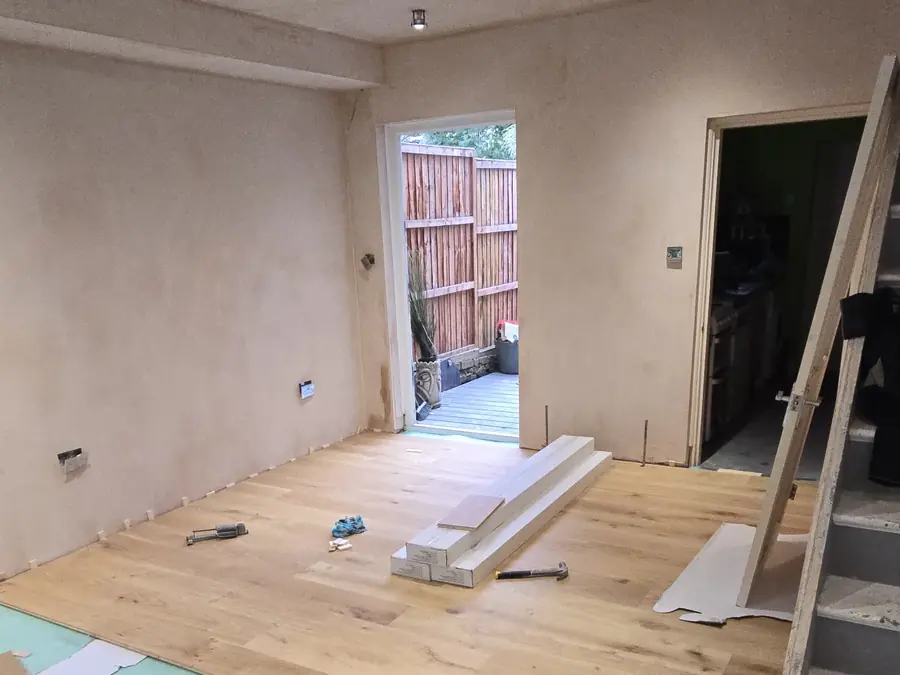
What a pre-1919 Kensington townhouse needs when it is renewed
A Kensington townhouse built before 1919 is renewed in its own materials, and the survey sets the order. In a house of that age the fabric to expect is solid brick in lime mortar, lath and plaster ceilings, and timber floors on joists notched by a century of cables and pipes. Hard cement render and gypsum patches trap moisture in that kind of wall, so repairs follow the original materials wherever the old plaster is sound enough to keep. If the house is listed, internal works that affect its character, from plaster to joinery and floors, need listed building consent first.
The order of works in a whole house runs strip, first fix, plaster, second fix and finish. Stripping out shows the joists, the lintels and the state of the stair, and any timber or damp repair is priced from what is found rather than guessed at. First fix covers the full rewire, certified by a registered electrician, and the replumb and heating runs, with gas work done by an engineer on the Gas Safe Register. Lime and lath repairs then need drying time before decoration, and that time sits in the programme from day one.
Housing in Kensington
Kensington has around 9,000 homes on the Council Tax list: 19% post-war, 6% interwar and 75% predate 1919, with 85% flats and 15% houses. Where most homes in Kensington are flats, a whole house is refurbished as one building, with a single intake for the services and one roof to keep sound, which matters here because most homes are flats.
Sash windows, front doors and roofs on a Kensington house
Window work on a Kensington house faces two separate tests, and both are settled before anything is ordered. The council's Householders' Guide to windows states that building regulations apply to all replacement windows, so a new sash has to meet current thermal and safety requirements as well as match the old one. On the planning side, the council has consulted on a Windows Local Development Order to remove the need for separate planning permission to change existing windows in non-listed homes, and your designer checks whether it has been made.
Conservation areas cover more than 73 per cent of the borough, and the Kensington Conservation Area was formed in 1976 by extending and joining separate areas designated in the 1970s. On a house in a conservation area, repairs to the front door, roof slopes, parapets and chimney stacks are best done like for like, and anything that changes the look of the front goes to your designer before the scaffold goes up. The council has also drafted a Local Listed Building Consent Order for windows, but under it similar works to Grade II* buildings, and to those in the highest grade, would still need an application for listed building consent.
Weekday hours for noisy work on a Kensington house
On a Kensington house refurbishment, loud work happens on weekdays only. The Royal Borough's final draft Code of Construction Practice sets permitted hours of 8am to 6pm, Monday to Friday, for noisy works audible at the site boundary, with none on Saturdays, Sundays or public holidays. A terraced house shares party walls on both sides, so the neighbours hear the chasing for a rewire and the hacking off of old plaster as clearly as any demolition, and the programme is written with that in mind.
High impact work has tighter windows still. Demolition and concrete-breaking, which in a house means taking up old screeds, breaking out a hearth or cutting through a floor slab for new services, is restricted to 9am to noon and 2pm to 5:30pm on weekdays. We group those tasks into a few set days near the start, and fill the rest of each day with quieter jobs such as setting out, joinery repairs and first fix in rooms that are already stripped. Keeping those days fixed stops every later trade from sliding.
Scaffold licences and van bays outside a Kensington house
A Kensington house refurbishment that needs a scaffold for the roof, gutters or front stucco cannot put it up until the council has approved a licence in writing. Scaffolding, hoarding, gantries and mobile towers on the public highway each need a temporary structure licence, and no work on the highway may start before that approval. The scaffolder normally applies, and the approval date decides when roof and chimney stack repairs can begin, so we sequence the inside work around it.
Vans and waste need the same forward planning on a residential street. The council suspends parking bays for building or maintenance works where the trades use vans, not cars, so the request names the vans and the days they are needed. If the house has an agreed Construction Traffic Management Plan, the council's Construction Management Team handles suspensions and licences and only issues the suspensions agreed in it. A skip on the road needs its own permission, and bagged waste collected from the front can be simpler on a narrow Kensington street.
- Consumer unit replacement, with earthing and bonding brought up to standard
- Part L insulation where outside walls, floors or roofs are renovated
- Staircase repairs: treads, risers, strings, balusters and newel posts
VOA Council Tax stock of properties, March 2025, for Kensington Abingdon and Kensington Gardens. Counts rounded by the VOA.
Why Choose GS Renovation in Kensington
A whole house is easier to renew when one team holds the sequence. We survey the fabric, price the repairs from what the strip out shows, and put the demolition days, scaffold licence and bay suspensions into one programme before work starts. Our team handles the stripping, carpentry, plastering, joinery and decoration, a registered electrician certifies the rewire, and gas work is done by an engineer on the Gas Safe Register. If you are living in the house, we phase it floor by floor so part of it stays usable throughout.
- Empty and inherited houses secured and reported on while you are away
- Lime plaster kept on solid walls where gypsum would trap moisture
- Photographs kept at each stage for your records
George always kept to commitments and arrived on time. He offered helpful suggestions during his initial visit and promptly provided a reasonably…
We loved working with George and Ibrahim and would highly recommend them. They have done splendid job on our new kitchen refurb which including new…
It's the second time I have hired George and he has been absolutely professional and the work he did resembles perfectly what I had in mind. Being an…
FAQ
Frequently Asked Questions about House Refurbishment Kensington
How much does a house refurbishment cost in Kensington?
Published UK figures put a three-bed house refurbishment at £43,530 to £110,350 (Checkatrade, 2026), and London houses usually cost more: a London architect allows £1,800 to £2,200 per square metre before VAT (Bradley Van Der Straeten Architects, 2026). For a Kensington house the survey decides where the job sits, from the wiring and pipework to the plaster, damp and roof. Each trade is then priced as its own line.
Can a Kensington house be refurbished while the family lives in it?
Yes, with phasing. We work floor by floor so a kitchen, a bathroom and bedrooms stay usable, and we keep the noisiest work inside the permitted hours of 8am to 6pm on weekdays set by the Royal Borough's final draft Code of Construction Practice. Rewiring and replumbing a lived-in house takes longer than an empty one, because power and water have to be restored at the end of each day.
Do building regulations apply to replacement sash windows on a Kensington house?
Yes. The council's Householders' Guide to windows states that building regulations apply to all replacement windows, so new sashes are made to meet current requirements, and an installer registered with a competent person scheme such as FENSA or Certass self-certifies them. Repairing and draught-proofing the existing sashes is a different job and can keep more of the original joinery. We price both routes where the frames are sound enough to compare.
Is a Kensington house likely to be in a conservation area?
Quite possibly, but check the street. Conservation areas cover more than 73 per cent of the Royal Borough, according to the publication version of the New Local Plan Review, and that is a borough-wide figure. Your designer or the council's map confirms the status of a particular house. It matters because changes to the front, roof and windows face closer scrutiny, and if the house is also listed, internal works can need listed building consent too.
When can demolition happen on a house refurbishment in Kensington?
Between 9am and noon and between 2pm and 5:30pm, Monday to Friday. The final draft Code of Construction Practice treats all demolition and concrete-breaking works as high impact activities with those restricted hours. On a house that covers breaking out old screeds and hearths, so we group those tasks into set days early in the programme.
Does a scaffold for Kensington roof and gutter repairs need a licence?
Yes, if it stands on the public highway. Scaffolding, hoarding, gantries and mobile towers there each need a temporary structure licence from the council, and no work on the highway may start until the licence is approved in writing. The scaffolder normally applies, and roof, gutter and chimney stack repairs are programmed from the approval date.
What does a full rewire involve in a house built before 1919?
Every circuit is replaced back to a new consumer unit, with cables chased into walls or run under lifted floorboards. In a house of that age the ceilings are often lath and plaster, so we plan the cable routes to limit how many ceilings are opened. A registered electrician tests and certifies the installation before plastering starts.
Should damp in an old solid brick house be treated with injected chemicals?
Not before the cause is found. In solid brick houses built with lime mortar, damp often comes from failed gutters, bridged ground levels, leaking pipes or cement render that traps moisture. Fixing the source and repairing in breathable materials tends to work better than an injected course. We open up, find the cause and price the repair from what is there.
What order does a whole house refurbishment in Kensington follow?
Strip out, first fix, plaster, second fix and finish. Stripping out exposes the joists, lintels and pipework, and the repairs they need go in next. First fix covers wiring, plumbing and heating runs, then walls are plastered and left to dry before second fix fittings and decoration. The demolition days also have to fit the restricted weekday hours.
Every Service, One Team
More GS Renovation Services in Kensington
One team for every GS Renovation service in Kensington:
Same Service, Nearby Areas
House Refurbishment Near Kensington
We carry out house refurbishment across Kensington and the surrounding areas. Explore a nearby location:
Ready to Start Your Kensington Project?
Free, no-obligation quote for house refurbishment in Kensington.