House Refurbishment Battersea
Whole-house refurbishments in Battersea, every floor of the house renewed from the roof down, in the right order.
- Rated 4.9 from 31 reviews on MyBuilder
- UK guide: £43,530 to £110,350
- Free site survey, itemised quote
House refurbishment in Battersea is a smaller market than the flat work around it, and we say so plainly: 91% of homes here are flats and 9% are houses. The houses that exist are mostly the terraces, 7% of all homes, and 19% of Battersea's stock predates 1919. A whole-house job here means renewing the services, plaster, floors and joinery of a Victorian terrace on a street where skips and scaffold need a Wandsworth licence.
For Battersea, published UK figures put a three-bed house refurbishment at £43,530 to £110,350, and London houses usually cost more, with a London architect allowing £1,800 to £2,200 per square metre before VAT (Checkatrade and Bradley Van Der Straeten Architects, 2026). GS Renovation Ltd, a building contractor based in Potters Bar, does the work in Battersea: we renew the wiring, pipework, heating, plaster, floors and joinery of the whole house under one contract, and a registered electrician certifies the rewire.
Price guide
| Work | Indicative range |
|---|---|
| Three-bed house refurbishment, UK average | £43,530 to £110,350 |
| Non-structural house refurbishment in London, per square metre, excluding VAT | £1,800 to £2,200 per square metre |
| Full rewire, two-bed to five-bed house | £4,500 to £10,500 |
| New heating system, three-bed house | £3,000 to £8,500 |
| Re-skim walls and ceilings, three-bed house | £5,000 to £12,500 |
Indicative ranges from published cost guides (Checkatrade, Bradley Van Der Straeten Architects and MyJobQuote, 2026), not a quotation. Most are UK-wide figures and London work usually costs more; a row marked London is a London figure. Prices checked September 2026. Full breakdown: House Rewire Cost.
Quick estimate from UK guide figures
Guide range: choose above
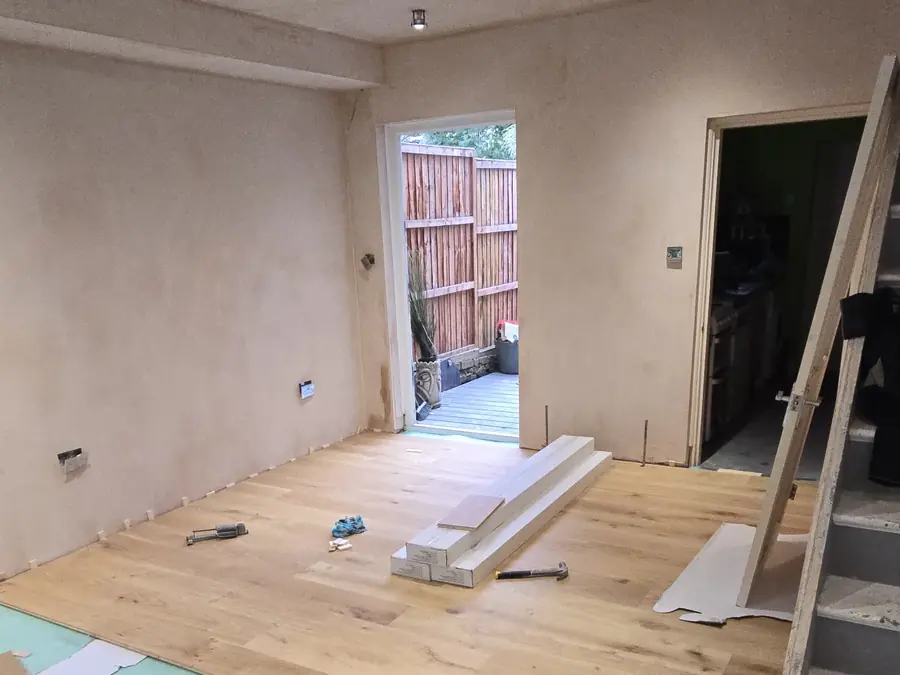
What a Victorian Battersea terrace needs when it is renewed
A Battersea terrace built before 1919 needs its fabric read before anything is stripped. 19% of the area's homes date from then, against 4% from the interwar years. Expect lath and plaster ceilings, lime-based plaster on solid brick walls, suspended timber ground floors with a void beneath, and a stair and joinery that have been painted many times. Each of those decides the method, because gypsum and cement do not sit well on walls that were built to breathe.
The services in these houses have usually been extended in stages rather than replaced in one go. A full rewire, certified by a registered electrician, and a replumb with new heating are the backbone of the job, and they need the floors lifted and the walls chased. That is why we run them before any plastering: first fix goes in while the house is open, the ceilings and walls are then made good in compatible materials, and second fix and decoration follow.
Housing in Battersea
Count the homes in Battersea and you get about 33,740: 76% built since 1945, 4% between the wars and 19% before 1919, with flats at 91% and houses at 9%. Since most homes here are flats, a whole house in Battersea is refurbished as one building, roof down.
Article 4 and the Latchmere Estate terraces in Battersea
Some Battersea houses sit where permitted development has been cut back, and a refurbishment has to respect that from the survey onwards. Wandsworth lists eight conservation areas subject to Article 4 Directions, and the Latchmere Estate is one of them. The council's appraisal describes the estate as one of the last remnants of traditional streets of Battersea terraced housing between Battersea Park Road and the main railway line. Under its direction, extensions to the house and porches at the front need planning permission.
For a refurbishment that usually means keeping the front of the house as it is while the inside is renewed. Replacement windows, a new front door or a changed boundary are the items to check with Wandsworth before anything is ordered, because a conservation area judges them on appearance. Like-for-like repair of sashes, brickwork and roof coverings is the safer route, and it is also the one that suits a Victorian house. Your designer or agent handles any application, and we build to what is approved.
Skips and scaffold outside a Battersea house
A skip on a Battersea street needs a Wandsworth licence, and the minimum licence period is five days. The largest skip allowed on the highway is 12 cubic yards (9.2 cubic metres), and no licence can be issued for a red route. The skip hire firm applies, and its application needs a certificate of public liability insurance for the licence period. On a terrace with no forecourt, the strip-out week is planned around the day the skip can actually be placed.
Scaffold for roof, gutter, chimney-stack or front elevation repairs needs its own licence, with an inspection fee on each application and renewal under the charges valid from 1 April 2026 to 31 March 2027. The scaffolder arranges that licence. We line the scaffold up with the roofer and the survey findings, so the repairs are done in one visit and the scaffold comes down as soon as the work above the gutter line is signed off.
Living in a Battersea house or refurbishing it empty
Whether you stay in the Battersea house during the work changes the whole programme. An empty house can be stripped in one pass, rewired and replumbed floor by floor, and plastered throughout before any finishes go in. A house you live in has to be phased, usually keeping one bathroom and a kitchen area working while the rest is done, which adds time and more protection. The same applies to executors preparing a probate sale or a landlord re-letting a whole house between tenancies.
Where a Battersea house is being refurbished for letting, its energy rating matters as well. Since 1 April 2020 the minimum standard stops a landlord continuing an existing let, as well as starting a new tenancy, while the EPC rating is below E, unless a valid exemption is registered. Renewing windows, heating and insulation during a refurbishment is the practical time to lift the rating, and building regulations apply to thermal performance when those elements are replaced. We agree those measures with you at the start rather than adding them later.
- New boiler, cylinder and radiators sized to every room, fitted by a Gas Safe registered engineer
- Panelled doors eased and rehung, skirtings and architraves pieced in to match
- Damp investigation, repair of the cause and making good
VOA Council Tax stock of properties, March 2025, for all 6 statistical areas in Battersea. Counts rounded by the VOA.
The GS Renovation Difference in Battersea
A whole-house refurbishment is many trades in the right order, and we run that order for you: strip-out, first fix, plaster, second fix, then decoration. We survey the house before pricing it, so the lime plaster, old joists and patched services are in the quote rather than found halfway through. The skip hire firm and scaffolder are booked to the programme. A registered electrician certifies the rewire and a registered gas engineer does the boiler work, and their certificates come to you at handover.
- Provisional sums for what lies behind the plaster shown as separate lines
- Straight advice on what is and is not worth spending money on
- First fix cabling on each floor inspected by the electrician before the walls are closed
George always kept to commitments and arrived on time. He offered helpful suggestions during his initial visit and promptly provided a reasonably…
We loved working with George and Ibrahim and would highly recommend them. They have done splendid job on our new kitchen refurb which including new…
George was brilliant. Lovely bloke, very reasonably priced and a perfectionist to boot. He completed our small kitchen renovation with care and great…
FAQ
Frequently Asked Questions about House Refurbishment Battersea
Why do house refurbishment quotes in Battersea differ so much?
Because they rarely price the same work. One quote includes making good, the electrician's certificate for the rewire and the Gas Safe sign-off on a new boiler; another leaves them as extras. Published UK figures of £43,530 to £110,350 for a three-bed house (Checkatrade, 2026) are a floor for London work. Compare Battersea quotes line by line rather than by the total.
Are there many houses to refurbish in Battersea?
Relatively few. 91% of Battersea homes are flats and 9% are houses, with terraced houses making up 7% of the total and semi-detached or detached houses 2%. So most house refurbishments here are terraces, where the work is planned around a narrow street frontage and a licence for the skip.
Does a Battersea house in the Latchmere Estate need consent for refurbishment works?
Internal renewal does not, unless the house is listed, but some outside changes do. The Latchmere Estate is one of eight Wandsworth conservation areas with an Article 4 Direction, and under it extensions and porches at the front of the house need planning permission. Check windows, doors and boundaries with Wandsworth before ordering them, and keep repairs like for like.
Can a skip go outside a Battersea terrace?
Yes, with a licence, unless the house fronts a red route. Wandsworth needs a licence for a skip on a public road, with a minimum period of five days, and cannot issue one for a red route. The maximum skip size is 12 cubic yards. Where a skip cannot go, waste leaves by bagged collection instead.
Who arranges the scaffold licence for roof repairs on a Battersea house?
The scaffolder applies for the licence, and Wandsworth charges an inspection fee on each application and renewal. We book the scaffold for the dates the roofer, gutter and chimney-stack repairs need it, so it is up for as short a time as possible and the licence does not need renewing.
Should old plaster in a Battersea Victorian house be replaced?
Only where it has failed. Sound lath and plaster ceilings and lime plaster on solid walls can be repaired, and they suit a building that was designed to breathe. Where a ceiling has come away from its laths or a wall is damp, we replace that area in compatible materials rather than hard cement or gypsum over lime.
What order does a whole-house refurbishment follow?
Strip-out first, then first fix of the new wiring, pipework and heating, then plastering, second fix and decoration. Floors and joists are repaired while they are open, and any damp or timber treatment is done before walls are closed. Keeping to that order stops finished work being cut open again for a late cable or pipe.
Can the owner stay in a Battersea house while it is refurbished?
Yes, if the work is phased. We keep a working kitchen area and one bathroom while other rooms are done, and seal off dust between areas. It takes longer than an empty-house programme, because trades return to each phase, so some owners move out for the rewire and plastering stage.
Does a landlord refurbishing a Battersea house need to improve its EPC?
If the rating is below E, yes. Since 1 April 2020 a landlord cannot grant a new tenancy or continue an existing one while the EPC rating is F or G, unless a valid exemption is registered. A refurbishment that renews the heating, windows or insulation is the practical moment to raise the rating before the next tenancy.
Every Service, One Team
More GS Renovation Services in Battersea
One team for every GS Renovation service in Battersea:
Same Service, Nearby Areas
House Refurbishment Near Battersea
We carry out house refurbishment across Battersea and the surrounding areas. Explore a nearby location:
Ready to Start Your Battersea Project?
Free, no-obligation quote for house refurbishment in Battersea.