House Refurbishment Highgate
Whole-house refurbishments in Highgate, every floor of the house renewed from the roof down, in the right order.
- Rated 4.9 from 31 reviews on MyBuilder
- UK guide: £43,530 to £110,350
- Free site survey, itemised quote
House refurbishment in Highgate covers the smaller part of the stock: 31% of homes across the VOA statistical areas that cover Highgate, which run into Highgate Wood, are houses, made up of 16% terraces and 15% semi-detached or detached. The stock is old: 47% of all Highgate homes were built before 1919 and 24% between the wars, so renewing a whole house means new wiring, pipework, heating, plaster and joinery inside period fabric, with the rooms left where they are. We run that work as one programme for owners, buyers of a dated house, landlords and executors.
For Highgate, published UK figures put a three-bed house refurbishment at £43,530 to £110,350, and London houses usually cost more, with a London architect allowing £1,800 to £2,200 per square metre before VAT (Checkatrade and Bradley Van Der Straeten Architects, 2026). GS Renovation Ltd, a building contractor based in Potters Bar, does the work in Highgate: we renew the wiring, pipework, heating, plaster, floors and joinery of the whole house under one contract, and a registered electrician certifies the rewire.
Price guide
| Work | Indicative range |
|---|---|
| Three-bed house refurbishment, UK average | £43,530 to £110,350 |
| Non-structural house refurbishment in London, per square metre, excluding VAT | £1,800 to £2,200 per square metre |
| Full rewire, two-bed to five-bed house | £4,500 to £10,500 |
| New heating system, three-bed house | £3,000 to £8,500 |
| Re-skim walls and ceilings, three-bed house | £5,000 to £12,500 |
Indicative ranges from published cost guides (Checkatrade, Bradley Van Der Straeten Architects and MyJobQuote, 2026), not a quotation. Most are UK-wide figures and London work usually costs more; a row marked London is a London figure. Prices checked September 2026. Full breakdown: House Rewire Cost.
Quick estimate from UK guide figures
Guide range: choose above
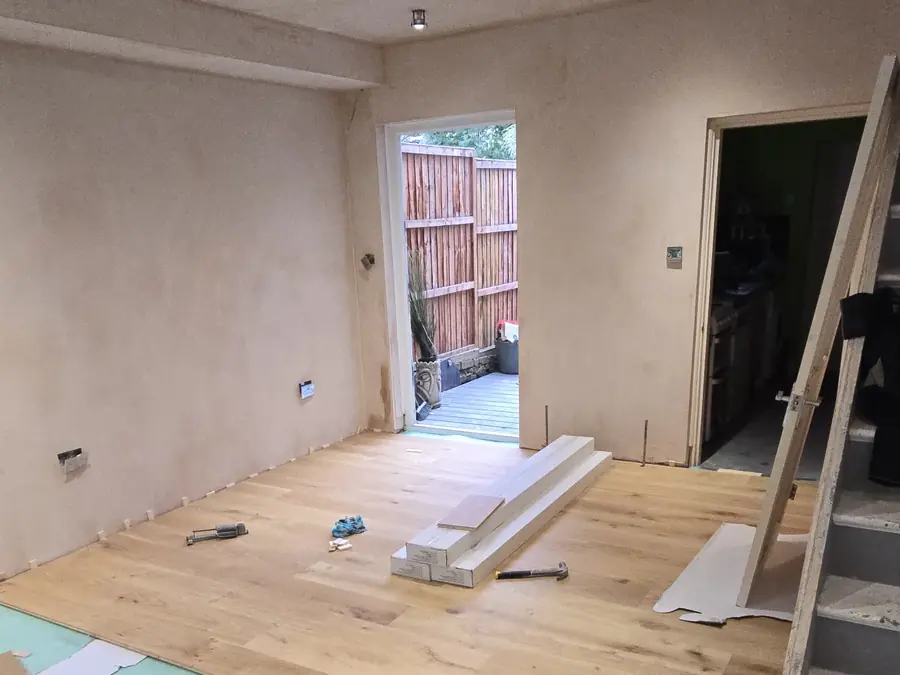
What a whole-house refurbishment in Highgate renews
A whole-house refurbishment in Highgate renews the services and surfaces of the building while the plan stays as it is. The age mix sets the scope: 47% of homes date from before 1919, 24% from 1919 to 1939 and 28% from after 1945. A Victorian or Edwardian house brings lath and plaster ceilings, lime-bedded brickwork, sash windows and timber ground floors over a void. An interwar house brings early cavity walls, original casements and a fuse board that several owners have added to.
The services are normally the first thing to be renewed. A full rewire is carried out and certified by a registered electrician, the boiler and gas pipework are handled by an engineer on the Gas Safe Register, and we replumb in modern pipe while the boards are up. Joists are checked wherever floors are opened, notched or decayed timbers are repaired, and stairs are eased and made good. Where a wall, floor or roof is renewed, Part L insulation applies, so that detail is agreed before plastering starts.
Housing in Highgate
Highgate has about 10,090 homes on the Council Tax list: 47% pre-1919, 24% interwar and 28% post-war, with flats making up 69% and houses 31%. Where most homes in Highgate are flats, a whole house is refurbished as one building, with a single intake for the services and one roof to keep sound, which matters here because most homes are flats.
Sequencing and phasing a Highgate house refurbishment
A Highgate house refurbishment follows a fixed order: strip out, repairs to structure and fabric, first fix of cables and pipes, plastering, second fix, then decoration. Each stage has to be finished and checked before the next one covers it, which is why the programme is written room by room. In an empty house, as with a probate sale or a purchase before moving in, every floor can be stripped at once and the trades move through the building in one pass.
If you are living in the house in Highgate, we phase it instead. One floor or one end is sealed and worked on while you keep a bathroom, a place to cook and a clean route through the rest. For notifiable work, a house owner can use a Camden building notice, which lets work start within 2 days of applying without detailed plans. Camden treats commencement and completion as the statutory inspections and wants 48 hours of notice before work begins.
Conservation and heritage rules on the outside of Highgate houses
Highgate was designated as a Conservation Area in 1968 and extended in 1978 and 1992, so check whether your house sits inside the boundary before any external work is priced. Like for like repairs, such as sashes re-corded and reglazed, slipped slates refixed, lime repointing and chimney stacks rebuilt in matching brick, keep the house as it was. A stack shared with next door is a party structure, so rebuilding it needs a party wall notice, which the owner serves. Replacing windows, doors or roof coverings with a different design is another matter, so ask Camden before ordering. An application for alterations in a Camden conservation area must include a heritage statement.
Camden has more than 5,600 listed buildings, so confirm whether your Highgate house is one of them. Any change to a listed building needs listed building consent, which is separate from planning permission, and that reaches inside: renewing lath and plaster, stripping panelling or altering a staircase. The owner or their designer applies, and we work to the consented schedule. Camden also keeps a Local List of non-designated heritage assets, adopted on 21 January 2015, which is worth checking for a period house.
Hours, skips, parking and scaffolding for a Highgate house
Noisy work on a Highgate house runs within Camden's permitted hours: 8am to 6pm on weekdays and 8am to 1pm on Saturdays. Anything noisy outside those times needs a Section 61 prior consent application at least 28 days before the works. Stripping plaster, chasing walls for cables and breaking out old hearths are the loud jobs, so we put them in the morning blocks and keep measuring, first fix and decorating for the quieter parts of the day.
A house refurbishment in Highgate produces a lot of waste, from lath and plaster to old boards and pipework. In Camden only a skip company can apply for a skip licence, at least 5 working days before it is needed, and skips cannot sit on the pavement. For a delivery or skip bay outside, book the parking bay suspension at least 17 days ahead. Scaffolding for roof, gutter or chimney repairs needs a Camden building licence, which lasts at most 6 months.
- Floorboard lifting, joist repairs and relaying on every floor
- Pre-sale and probate refurbishments of empty houses
- Smoke, heat and carbon monoxide alarms fitted to current rules on every storey
VOA Council Tax stock of properties, March 2025, for Highgate West, Highgate East and Highgate Wood. Counts rounded by the VOA.
Why Highgate Homeowners Choose GS Renovation
A house refurbishment is a long chain of trades, and the finish depends on the order in which they arrive. We run the strip out, repairs, first fix, plastering, second fix and decoration as one programme with one named contact, and bring in a registered electrician and an engineer on the Gas Safe Register for their parts. GS Renovation is run by its founder, Abdelaaziz Saaid, who has decades of hands-on building experience. You get a written quotation, confirmed once we have opened up a sample of the walls, floors and ceilings.
- Every wall of the house tapped and every circuit tested before the refurbishment is priced
- A top-floor-first programme when your family stays in the house
- Rated 4.9 from 31 reviews on MyBuilder
We loved working with George and Ibrahim and would highly recommend them. They have done splendid job on our new kitchen refurb which including new…
George always kept to commitments and arrived on time. He offered helpful suggestions during his initial visit and promptly provided a reasonably…
It's the second time I have hired George and he has been absolutely professional and the work he did resembles perfectly what I had in mind. Being an…
FAQ
Frequently Asked Questions about House Refurbishment Highgate
How much does a house refurbishment cost in Highgate?
Published UK figures put a three-bed house refurbishment at £43,530 to £110,350 (Checkatrade, 2026), and London houses usually cost more: a London architect allows £1,800 to £2,200 per square metre before VAT (Bradley Van Der Straeten Architects, 2026). For a Highgate house the survey decides where the job sits, from the wiring and pipework to the plaster, damp and roof. Each trade is then priced as its own line.
What does a full refurbishment of a Highgate period house include?
It renews the whole house without changing its layout: rewiring, replumbing, a new heating system, replastering, floor and joist repairs, joinery, window repairs and decoration. In Highgate, where 47% of homes were built before 1919, that means lime and lath and plaster repairs in many rooms rather than plasterboard throughout. Moving walls or rearranging rooms is home renovation, and extensions are a separate service.
Can a family live in a Highgate house while it is refurbished?
Yes, if the works are phased. We seal off the rooms being worked on, keep a bathroom and somewhere to cook in use, and clean down at the end of each day. The dusty stages, stripping out and first fix, are the hardest to live through, so some owners move out for those weeks and return for plastering and finishing. An empty house gives the shortest programme.
When can noisy work happen on a house in Highgate?
Camden lets noisy building work go ahead without authorisation from 8am to 6pm Monday to Friday and 8am to 1pm on Saturday. Outside those hours a Section 61 prior consent application is needed at least 28 days before the work. We plan stripping, cutting and breaking out inside the permitted times and leave quiet tasks for the edges of the day.
Does a Highgate house refurbishment need building regulations approval?
Parts of it do. A rewire, new heating, replacement windows and renewed thermal elements such as a roof or floor all fall under the building regulations, and several are notified by the registered trade who does them. For other notifiable work, a house owner can use a Camden building notice and start within 2 days of applying, or make a full plans application and get a decision within 6 weeks.
Is permission needed to replace the windows of a Highgate house?
Check with Camden before ordering. Highgate was designated as a Conservation Area in 1968, and changing the design or material of windows in a conservation area can need planning permission. Where an application is made, Camden requires a heritage statement with it. Repairing the original sashes like for like, with new cords, beads and draught strips, keeps the house as it was and avoids the question.
Where does the skip go for a Highgate house refurbishment?
On your drive if there is room, which needs no licence, or on the road with one. In Camden only a skip company can apply for a skip licence, at least 5 working days before it is needed, and skips are not allowed on the pavement. On a narrow street we use bags and timed collections, and book any parking bay suspension at least 17 days ahead.
Does a landlord have to improve the EPC before reletting a whole house?
Yes, if the rating is F or G. Since 1 April 2018 private landlords may not grant a new tenancy on a home rated F or G unless an exemption applies, and since 1 April 2020 that covers continuing lets too. An assessor identifies the improvements, such as loft insulation, heating controls or draught proofing, and a refurbishment between tenancies is a sensible time for us to build them before the new certificate.
Can a probate house in Highgate be refurbished before it is sold?
Yes. Executors usually want a house made safe, sound and presentable rather than remodelled: electrics tested and renewed where needed, heating that works, roof and gutter repairs, fresh plaster and decoration. We price the work room by room so the estate can decide which items are worth doing before marketing, and set a programme that fits the sale timetable.
Every Service, One Team
More GS Renovation Services in Highgate
One team for every GS Renovation service in Highgate:
Same Service, Nearby Areas
House Refurbishment Near Highgate
We carry out house refurbishment across Highgate and the surrounding areas. Explore a nearby location:
Ready to Start Your Highgate Project?
Free, no-obligation quote for house refurbishment in Highgate.