Key Takeaways
- Restraint strap repairs typically total £1,500 to £4,000, including the structural engineer at £300 to £600.
- Sight along the elevation. A bow you can see from the pavement is worth investigating this month, not next year.
- The usual cause is lost lateral restraint: the wall is no longer tied to the floors and roof that used to hold it straight.
- On a cavity wall, bulging of the outer leaf alone is more likely corroded wall ties than true bowing.
- Repair is normally straps and helical ties. Rebuilding is the answer only where the wall has gone too far out of plumb.
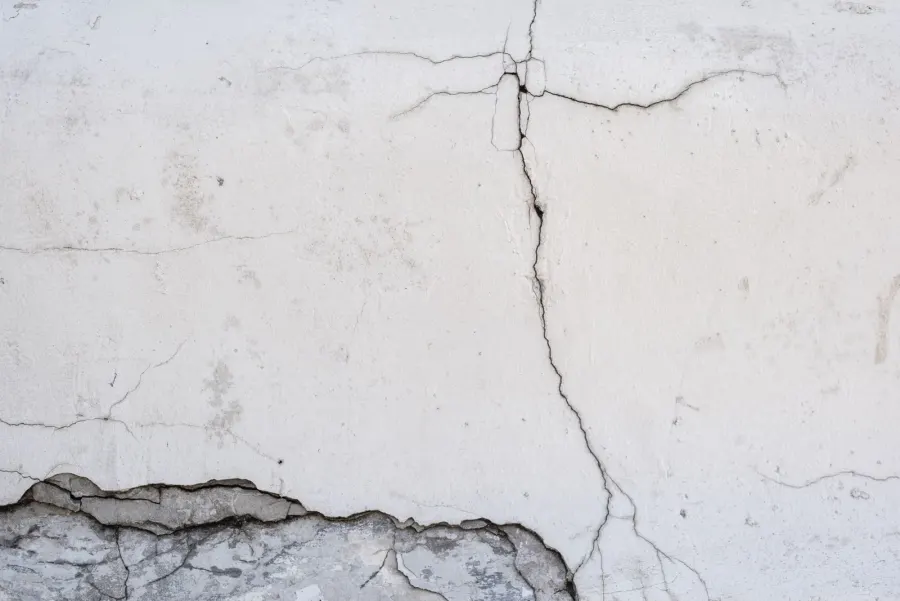
A wall that bulges outward has stopped being held straight by something. Working out what that something was, and why it stopped, decides whether you are buying a few hundred pounds of straps or rebuilding an elevation.
How do you tell a bow from a bad rendering job?
Sight along the wall. Stand at one corner, put your eye close to the brickwork and look down the length of the elevation. A true bow reads immediately as a curve; uneven render reads as roughness. Do it on the flank wall and the rear as well, because bulging often shows on one elevation only.
Then look for what goes with it. Cracking at the junction between the bulging wall and the walls that return off it. Floors that feel springy in the room behind. Gaps opening where the ceiling meets the wall. On a period house, joist ends that have pulled away and left a shadow line on the plaster. Any of these alongside a visible bow moves this up the list.
A rough rule used by surveyors is that a bow beyond about a third of the wall's thickness is significant. You do not need to measure that precisely to act. If you can see a curve from the pavement, get it assessed.
What causes a wall to bow outward?
Loss of lateral restraint, in most cases. A masonry wall is thin relative to its height and is not stable on its own. It stays straight because the floors and the roof are tied into it and hold it in place. Take that restraint away and the wall slowly leans.
- Joist ends rotted where they bear into a damp external wall, so the floor no longer restrains it
- A floor removed or altered during earlier work without replacing the restraint it provided
- Roof spread, where the rafters push the tops of the walls outward because the ties were cut or never adequate
- Corroded wall ties on a cavity wall, which lets the outer leaf move independently of the inner one
- Original construction, particularly a half brick closet wing or a flank wall built tall with little bracing
- Thermal or moisture movement over a long period in a solid wall with no movement joints
The distinction that matters most is cavity against solid. On a cavity wall, an outer leaf that bulges while the inner leaf stays put is usually a wall tie problem and is fixed as one. On a solid wall, a bow is the wall itself moving, and restraint is the answer.
What does bowing wall repair cost?
A restraint strap scheme on one or two elevations generally totals £1,500 to £4,000 once the engineer, the straps and the making good are counted. London and the South East sit at the upper end of that.
| Item | What it covers | Typical cost |
|---|---|---|
| Structural engineer | Inspection, diagnosis and a designed repair | £300 to £600 |
| Restraint straps, per wall | Supply and installation across the elevation | £800 to £1,500 |
| Plaster repair and redecoration | Internal making good where straps tie into floors | £300 to £600 |
| Typical total, front and rear | Engineer, straps and making good together | £1,500 to £2,500 |
| Larger or complex property | Difficult access, more elevations, helical stitching | £2,000 to £4,000 |
Rebuilding is the other outcome and it is a different order of cost. Where the wall has moved too far to be pulled back safely, sections of masonry come down and go back up, with scaffolding and weather protection for the duration. The engineer's report is what decides between the two, which is why it comes first.
How is a bowing wall repaired?
By giving the wall back the restraint it lost, rather than by pushing it straight. Nobody pushes a masonry wall back into plumb.
- A structural engineer inspects, establishes the cause and designs the repair. We appoint the engineer and build to that design
- Lateral restraint straps are fixed from the wall into multiple floor joists, usually at roughly two metre centres, so the floor holds the wall again
- Where joist ends have rotted, they are cut back to sound timber and repaired or supported before any strap is fixed to them
- Helical ties or brick stitching are used across cracks so the masonry acts as one panel again
- Roof spread is dealt with at the same time where that is the cause, since strapping the walls without addressing the push achieves little
- Movement is monitored where the engineer wants to confirm it has stopped before the finishes go back
Floorboards come up to fix straps to joists, so there is internal disruption in the rooms concerned, and plaster gets made good afterwards. Where the wall is shared with a neighbour the Party Wall etc. Act 1996 applies and notice is served by you, as set out in our Party Wall Act guide.
Who should you actually call first?
A structural engineer, not a builder and not a damp company. The engineer is diagnosing, and diagnosis is what you are short of. Around £300 to £600 buys an inspection and a written opinion, and that report is what lets you compare builders' quotes on equal terms rather than on their differing guesses.
GS Renovation is a contractor. We appoint structural engineers, build to their design and coordinate building control, and we do not produce calculations ourselves. If a builder offers to diagnose a bowing wall and design the fix in the same visit, that is worth a second opinion. Our guide on how to choose a builder in London covers what else to check, and cracks in walls and when to worry helps read the cracking that comes with it.