Key Takeaways
- Most cracks are category 0 to 2 under BRE Digest 251, up to 5mm wide, and are aesthetic rather than structural.
- Cracks of 5mm to 25mm affect how the building works, and anything over 25mm is a stability issue needing structural intervention.
- Direction tells you more than width: a diagonal stepped crack from the corner of an opening means movement, a repeating horizontal crack usually means wall tie failure.
- A crack wider at the top suggests subsidence; wider at the bottom suggests heave.
- A structural engineer's inspection and report costs £500 to £1,200, with London fees 20% to 30% higher (MyBuilder, 2026).
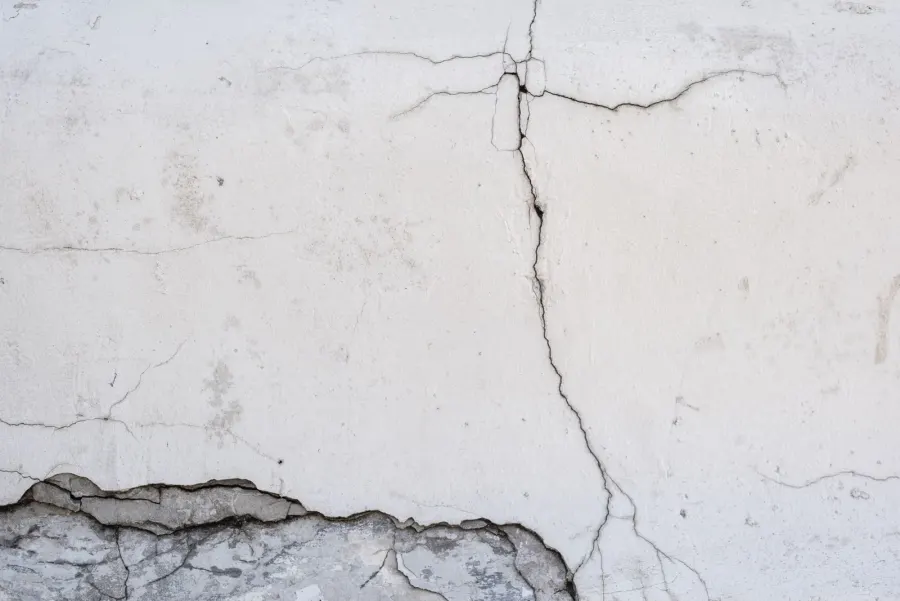
Almost every house in London has cracks, and the overwhelming majority mean nothing. A small number mean something serious. The difference is not how alarming the crack looks, it is the width, the direction, whether it goes through the brickwork as well as the plaster, and whether it is changing. This guide gives you the same framework a surveyor uses.
Are most cracks serious?
No. Fine hairline cracking is normal in any building and comes from plaster drying, seasonal timber movement, thermal expansion and ordinary settlement. Cracks that follow a plasterboard joint, cracks that open every winter and close every summer, and the fine map cracking you see in old plaster are all cosmetic. Fill them, decorate, forget them.
What changes the picture is a crack that is new, that goes through the masonry rather than only the finish, that shows in the same place inside and outside, or that is measurably wider than it was a month ago.
What does the width of a crack tell you?
Width is the standard way of classifying damage in a low-rise building. BRE Digest 251 sets out six categories, and the industry uses them because they connect a measurable number to a level of repair.
| Category | Typical crack width | What it means |
|---|---|---|
| 0, negligible | Up to 0.1mm | Hairline. No action needed |
| 1, very slight | Up to 1mm | Fine cracks, easily filled at redecoration |
| 2, slight | Up to 5mm | Filling and some repointing. Doors may stick slightly |
| 3, moderate | 5mm to 15mm | Cracks opened up and patched, brickwork repointed. Doors and windows stick, weather tightness may be affected |
| 4, severe | 15mm to 25mm | Extensive repair, sections of wall may need rebuilding. Openings distorted |
| 5, very severe | Over 25mm | Major repair, partial or full rebuilding. Instability |
The useful shorthand: categories 0 to 2 are aesthetic, 3 and 4 affect serviceability, and 5 is about stability. But the categories describe damage, not cause. A 10mm crack from thermal movement at an extension junction is a different problem from a 10mm crack from ground movement, and the width alone will not tell you which you have.
What does the direction of a crack tell you?
Direction and position are more diagnostic than width. These are the patterns worth learning:
- Diagonal and stepped, running through the mortar joints from the corner of a window or door. The classic movement crack. Openings are the weak points in a wall, so ground movement shows there first. Wider at the top points to subsidence, wider at the bottom points to heave.
- Horizontal, along a bed joint, repeating every few courses. On a cavity wall built between the 1920s and the 1980s this usually means corroded wall ties expanding in the joints. It is structural, it is progressive and it needs a specialist.
- Vertical at a corner, or at the junction of old and new brickwork. Usually thermal or differential movement where an extension meets the original house. Common, rarely serious, often needs a proper movement joint rather than filler.
- Roughly horizontal above a window or door, with a slight sag. A failing or missing lintel. Needs attention but is a local repair, not a foundation problem.
- Vertical crack running up a chimney breast, or across the ceiling where one used to be. Frequently an unsupported breast left in the loft or upper floor after a lower section was taken out. See chimney breast removal.
- Cracks radiating from the corners of a newly formed opening. Deflection in a beam, or undersized padstones. See RSJ installation.
When should you worry?
Treat a crack as needing professional assessment when it does several of these at once, not just one:
- Wider than about 5mm, or measurably growing month on month.
- Diagonal and stepped through the mortar, starting at a window or door corner.
- Appeared suddenly, particularly after a hot dry summer or after a nearby tree was removed.
- Visible on both the inside and outside face of the same wall, in the same place.
- Accompanied by sticking doors and windows or a visibly out of square opening.
- Wider at one end than the other.
One crack that ticks one box is usually nothing. A crack that ticks four is worth £600 of engineer's time.
What causes cracks that are not subsidence?
Most cracking has a cause that has nothing to do with the ground. In London housing the common ones are thermal movement in long unjointed walls and in render, shrinkage in newly applied plaster and screed, corroded wall ties, lintel failure over openings, chimney breasts removed without proper support above, and vibration from nearby construction or heavy traffic. In Victorian terraces, seasonal timber movement in floors and roofs opens and closes fine cracks at wall and ceiling junctions every year.
A crack that has been there for decades, is stable, and has been filled and reopened once or twice is behaving like thermal movement. A crack that did not exist last spring is behaving like something else.
Who should you call, and what happens next?
A chartered structural engineer, not a damp or underpinning contractor, because you want a diagnosis from someone who is not selling the remedy. A typical sequence:
- Measure the crack at its widest point and photograph it against a ruler with the date visible.
- Repeat monthly for three months. A stable crack and a moving crack are entirely different problems.
- If it is over 5mm, diagonal, or growing, instruct a chartered structural engineer. Expect £500 to £1,200 for an inspection and report, more in London.
- If the engineer suspects ground movement, tell your buildings insurer before commissioning any repair, because unauthorised work can prejudice a claim.
- Fit tell-tale gauges and monitor across a full seasonal cycle where movement is suspected.
- Fix the cause first. Then repair: cut out and stitch with helical bars, repoint, then replaster and decorate.
Do not simply fill a crack you are worried about. Filler hides the evidence, removes your ability to measure movement, and will crack again in the same line within a year.
Consent matters if the repair is structural. Removing or supporting a chimney breast, replacing a lintel or forming a new opening needs building regulations approval, and if the wall is shared you also need to serve notice under the Party Wall Act. GS Renovation carries out structural repairs and making good alongside engineers across London. For advice, contact us or call 07472 424 226.