House Refurbishment Wimbledon
Whole-house refurbishments in Wimbledon, every floor of the house renewed from the roof down, in the right order.
- Rated 4.9 from 31 reviews on MyBuilder
- UK guide: £43,530 to £110,350
- Free site survey, itemised quote
House refurbishment in Wimbledon means renewing a whole house without re-planning it: the wiring, pipes, heating, plaster, floors, windows and roof. Houses are 49% of homes here, 32% of all homes are terraced and 17% semi-detached or detached, and 52% of the stock was built before 1919. So a common job is a Victorian or Edwardian terrace or villa in SW19 that needs its services and fabric renewed in the right order, whether you live in it through the works or hand us the keys.
For Wimbledon, published UK figures put a three-bed house refurbishment at £43,530 to £110,350, and London houses usually cost more, with a London architect allowing £1,800 to £2,200 per square metre before VAT (Checkatrade and Bradley Van Der Straeten Architects, 2026). GS Renovation Ltd, a building contractor based in Potters Bar, does the work in Wimbledon: we renew the wiring, pipework, heating, plaster, floors and joinery of the whole house under one contract, and a registered electrician certifies the rewire.
Price guide
| Work | Indicative range |
|---|---|
| Three-bed house refurbishment, UK average | £43,530 to £110,350 |
| Non-structural house refurbishment in London, per square metre, excluding VAT | £1,800 to £2,200 per square metre |
| Full rewire, two-bed to five-bed house | £4,500 to £10,500 |
| New heating system, three-bed house | £3,000 to £8,500 |
| Re-skim walls and ceilings, three-bed house | £5,000 to £12,500 |
Indicative ranges from published cost guides (Checkatrade, Bradley Van Der Straeten Architects and MyJobQuote, 2026), not a quotation. Most are UK-wide figures and London work usually costs more; a row marked London is a London figure. Prices checked September 2026. Full breakdown: House Rewire Cost.
Quick estimate from UK guide figures
Guide range: choose above
What a pre-1919 Wimbledon house hides under the finishes
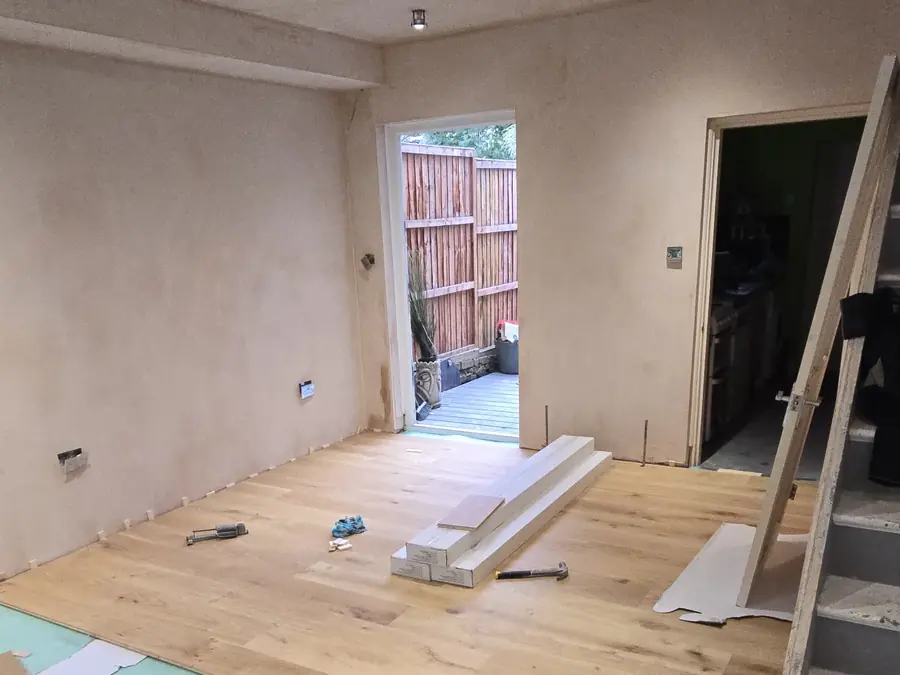
A Wimbledon house built before 1919 needs its fabric opened up and understood before any finish is chosen, and 52% of homes here fall in that age band. Behind the paint you tend to meet lath and lime plaster, suspended timber floors over a void, and a mix of old wiring and pipework left by several owners. Each of these changes the order of work, so opening up comes first and the kitchen brochure comes later.
Lime walls want to breathe, so we patch them with a compatible plaster rather than sealing them in gypsum and trapping damp. Timber floors get lifted where the rewire and new pipe runs need to pass, then relaid and firmed up before any tiles go down. A registered electrician tests and certifies the new circuits. Doing it in that sequence avoids chasing a freshly skimmed wall a second time for a forgotten cable.
Housing in Wimbledon
Take the 25,760 or so homes the valuation list gives Wimbledon: 51% flats, 49% houses, 52% from before 1919, 10% interwar and 38% post-war. Where most homes in Wimbledon are flats, a whole house is refurbished as one building, with a single intake for the services and one roof to keep sound, which matters here because most homes are flats.
Interwar and post-war Wimbledon houses need a different survey
Not every Wimbledon house is Victorian: 10% of homes here date from 1919 to 1939 and 38% from after 1945, though that later figure includes the post-war blocks. An interwar semi tends to have gypsum or early board ceilings, solid floors in the kitchen, and original steel or timber casements that have been replaced piecemeal. A post-war house often has a warm air or early wet system, thin cavity walls and a shallow roof pitch with a felt that has reached the end of its life.
That changes the survey. We look for cavity insulation and wall ties, for a roof covering that needs renewing rather than patching, and for the age of the consumer unit and the earth arrangement. Where you renew a roof, windows or a large area of wall finish, Part L of the building regulations applies to the renewed element, so insulation is planned in at that point rather than added later. The heating renewal is designed around the new, lower heat loss.
Skips, scaffold and noisy hours on a Wimbledon street
On a Wimbledon street, the skip licence comes from the skip hire company, because Merton only issues skip licences to private skip hire firms, not to residents or builders. Merton also keeps skips off the road during the Wimbledon Lawn Tennis Championships and local fireworks displays, so a strip out planned for the Championships weeks needs a different waste plan. A house with a front garden or drive can often take the skip off the highway altogether.
Roof, chimney and gutter repairs need scaffold, and Merton licenses scaffold on the highway per month and only to contractors or scaffold companies carrying a set level of public liability cover, so the scaffold firm applies. Noisy work should normally be kept to 8am to 6pm Monday to Friday and 8am to 1pm on Saturday, with none on Sundays and bank holidays. We put the stripping out, chasing and breaking up inside those hours and the quieter trades after them.
Wimbledon North and houses facing larger redevelopment
If your house sits in the Wimbledon North Conservation Area, check with Merton before renewing windows, doors or the roof covering on the front. Merton describes it as the land east of the south east corner of Wimbledon Common, and north and east of Wimbledon Village. In a conservation area, a like-for-like repair is the safe default: sash windows overhauled rather than swapped for a different pattern, and slate or tile matched on the street elevation. If the house is listed, listed building consent covers works inside as well as out.
Merton's character assessment for Wimbledon North records considerable pressure to redevelop individual houses with much larger dwellings. A refurbishment is the other route: it keeps the house and renews what is inside it. For a house you are selling, Merton issues a completion certificate for work it inspects and advises keeping it because it will be needed to sell the property, so we keep that with the electrical certificates in one pack.
- Roof, gutter and chimney-stack repairs coordinated as the survey requires
- Timber repairs where rot or beetle turns up at strip-out
- Sash boxes overhauled with new cords, parting beads and brush seals
VOA Council Tax stock of properties, March 2025, for all 7 statistical areas in Wimbledon. Counts rounded by the VOA.
Trusted House Refurbishment in Wimbledon
You get one firm to run a Wimbledon house refurbishment from strip out to decoration, with the trades in the order the fabric needs. We survey the house first, price the services and repairs before the finishes, and book skips, scaffold and noisy days around the street. A registered electrician certifies the wiring, an engineer on the Gas Safe Register does any gas work, and the building control paperwork is handed to you at the end, ready for a sale or a new tenancy.
- Lime plaster kept on solid walls where gypsum would trap moisture
- Building control applications and inspections coordinated for you
- Asbestos sampling arranged before textured ceilings or old floor tiles are disturbed
George always kept to commitments and arrived on time. He offered helpful suggestions during his initial visit and promptly provided a reasonably…
We loved working with George and Ibrahim and would highly recommend them. They have done splendid job on our new kitchen refurb which including new…
George was brilliant. Lovely bloke, very reasonably priced and a perfectionist to boot. He completed our small kitchen renovation with care and great…
FAQ
Frequently Asked Questions about House Refurbishment Wimbledon
What should I budget for a full house refurbishment in Wimbledon?
Start from the published UK range of £43,530 to £110,350 for a three-bed house (Checkatrade, 2026) and expect a London house to sit higher. Add a contingency for what only shows once plaster and floors are opened. The itemised quote after the Wimbledon survey shows each trade separately, so the work can be phased if the total is more than you want to spend at once.
What do older Wimbledon houses usually hide behind the plaster?
Lath and lime plaster, suspended timber floors and old wiring and pipework are the usual finds in a house built before 1919, and 52% of Wimbledon homes date from then. None of this is a problem once it is known. We open up the key areas early so the rewiring, plumbing and plastering can be priced and sequenced properly.
Can a skip sit on a Wimbledon road during the tennis championships?
No. Merton keeps skips off the road during the Wimbledon Lawn Tennis Championships and during local fireworks displays. A skip on your own drive or forecourt needs no highway licence. Otherwise, if your strip out falls in that window, plan for bagged waste collected by a registered waste carrier, or move the demolition phase either side of the tournament.
Who applies for the skip licence on a Wimbledon house job?
The skip hire company. Merton only issues skip licences to private skip hire firms, not to residents or builders, so the licence comes through whoever supplies the skip. We choose the skip company and fix the dates with them, and plan the loading so the skip is swapped before it overfills on a narrow terrace.
Can a family live in a Wimbledon house while it is refurbished?
Yes, if the work is phased. We finish one floor or zone at a time, keep one bathroom and a working kitchen point running, and put the rewire and replumb into short planned shutdowns. An empty house is quicker because every room can be stripped at once, so the choice is between speed and staying put.
What hours can noisy refurbishment work run on a Wimbledon street?
Merton says noisy construction work should normally be restricted to 8am to 6pm Monday to Friday and 8am to 1pm on Saturday, and not normally on Sundays and bank holidays. On a terrace, the party wall carries drilling straight into the house next door, so we tell the neighbours before the loud days.
Can the windows change on a house in the Wimbledon North Conservation Area?
Check with Merton first. The Wimbledon North Conservation Area covers the land east of the south east corner of Wimbledon Common and north and east of Wimbledon Village. Repairing sashes and matching the original pattern is the safer route; a different window design or material on the front may need planning permission.
Why keep the Merton completion certificate after a house refurbishment?
Merton issues a completion certificate when inspected work is finished and advises keeping it because it will be needed to sell the property. A buyer's solicitor will ask for it after a re-roof, new drainage or other work building control inspected. We keep it with the electrical certificates in one handover pack.
How is a probate house in Wimbledon made ready for sale?
Start with a survey of what really needs doing, then fix the fabric before the cosmetic work. On an older house that means damp, roof, wiring and heating first, then plaster, joinery and decoration. We give executors a clear scope and programme, and agree access and security with them for a house nobody lives in.
Every Service, One Team
More GS Renovation Services in Wimbledon
One team for every GS Renovation service in Wimbledon:
Same Service, Nearby Areas
House Refurbishment Near Wimbledon
We carry out house refurbishment across Wimbledon and the surrounding areas. Explore a nearby location:
Ready to Start Your Wimbledon Project?
Free, no-obligation quote for house refurbishment in Wimbledon.