Key Takeaways
- Budget £2,500 to £6,500 for the steel, calculations and Building Control on top of the kitchen itself.
- A workable kitchen, dining and living space needs roughly 30 to 40 m². Below 25 m² one zone always loses out.
- A six-seat table is 1,800 x 900 mm, plus 900 mm behind the chairs on every open side.
- Extraction is not optional. Approved Document F wants 30 litres per second at the hob.
- In a three-storey house, opening the hall into the kitchen can break the protected stair and trigger a fire strategy.
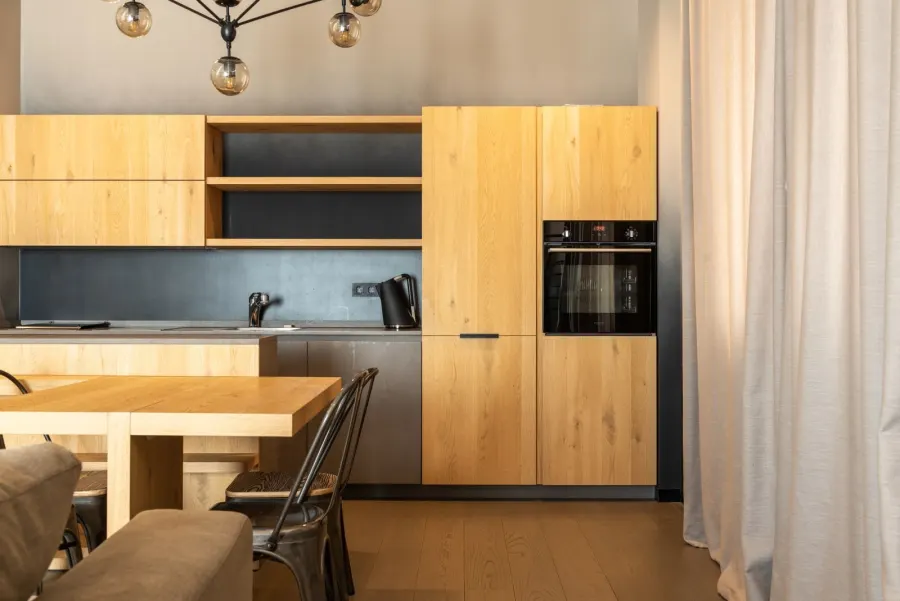
The open-plan kitchen-diner is the layout most London homeowners ask for, and the one where the ideas and the structural reality have to be settled together. Here is what makes them work, with the dimensions and regulations that decide it.
How they are created
In a typical London terrace an open-plan kitchen-diner is made by removing the wall between the kitchen and the rear reception room, usually alongside a side return or rear extension. That wall is nearly always load-bearing, so the job needs a steel beam, an engineer's calculations, padstones and Building Control sign-off, adding £2,500 to £6,500 to the kitchen budget.
Two things get missed here. If you are cutting into a wall shared with a neighbour, the Party Wall etc. Act 1996 applies and notice runs two months before work starts. And in a flat the lease almost always requires the freeholder's written consent, which takes longer than the steel does. See our knock-through guide.
Will Building Control let you open it up?
Usually yes in a two-storey house, not automatically in a three-storey one. Approved Document B expects a protected escape route from the upper floors, so if the knock-through leaves the staircase opening into a kitchen, Building Control will want a compensating fire strategy: interlinked mains-powered alarms, sometimes a misting system, sometimes a fire door retained at the hall.
It is a common reason a London scheme gets redesigned late, so settle it with your building control body before the kitchen is ordered. Our building regulations guide covers what else is notifiable.
Zone the space
Zoning is a dimensions problem before it is a styling one. Set the three zones out on paper first, because a space that cannot seat six is not rescued by a rug.
| Zone | Space needed | Notes |
|---|---|---|
| Dining, 6 seats | 3,600 x 2,700 mm | 1,800 x 900 mm table plus 900 mm behind chairs |
| Island and run | 3,650 mm wide | 1,000 to 1,200 mm clearance each side |
| Sofa and seating | 3,000 x 3,000 mm | Allow 400 mm between sofa and coffee table |
| Whole space | 30 to 40 m² | Under 25 m² one zone always loses |
Once the zones fit, define them with a kitchen island or peninsula, a change of flooring, a rug anchoring the living area, and pendants 750 to 900 mm above the island and dining table, each zone on its own circuit so the cooking end can be bright while the sofa end is not.
Consider broken-plan
Broken-plan keeps the light and loses the drawbacks. The usual moves are a half wall at 1,100 mm, high enough to hide the worktop and low enough to see over, a level change of 150 to 200 mm where the floor allows, or a Crittall-style screen that stops cooking smells and noise while passing daylight straight through.
Sound is why people regret going fully open. Hard floors, glass and a plastered ceiling make a lively room, so specify acoustic underlay, soft furnishings and a quiet extractor at design stage.
Heating, extraction and services
Open-plan removes the walls radiators used to live on, so underfloor heating is usually the answer, and it has to be decided before the floor build-up is fixed. Extraction matters more too, because there is no door between the hob and the sofa. Approved Document F asks for 30 litres per second adjacent to the hob, or 60 litres per second elsewhere, and a ducted unit beats a recirculating filter in a room this size.
Source: Approved Document F, Ventilation (gov.uk, 2026 edition).Flood it with light
Light is what makes open-plan feel generous rather than merely big. Rooflights over the deepest part of the plan do more than the same area of vertical glazing, because a horizontal opening sees the whole sky. Keep a glazed link where a side return meets the original house, and use sliding or bi-fold doors to the garden.
One limit worth knowing: Approved Document L sets a notional glazing allowance for an extension of 25% of its floor area, plus any openings closed up. Past that the design has to compensate on energy performance. More in maximising natural light.
We handle the structure and the kitchen fit-out as one project. See our open-plan conversions London page, or contact us on 07472 424 226.