Key Takeaways
- A galley needs 1,200 mm between the two runs. Below 900 mm, opposing doors clash.
- Protect 900 to 1,000 mm of uninterrupted worktop between hob and sink.
- Tall units at 2,150 to 2,300 mm hold roughly twice what a base and wall unit pair holds.
- An island needs 3,650 mm of room width. A peninsula works from about 2,700 mm.
- A small London kitchen runs £12,000 to £20,000, or £1,300 to £1,800 per m² (MyJobQuote and Checkatrade, 2026).
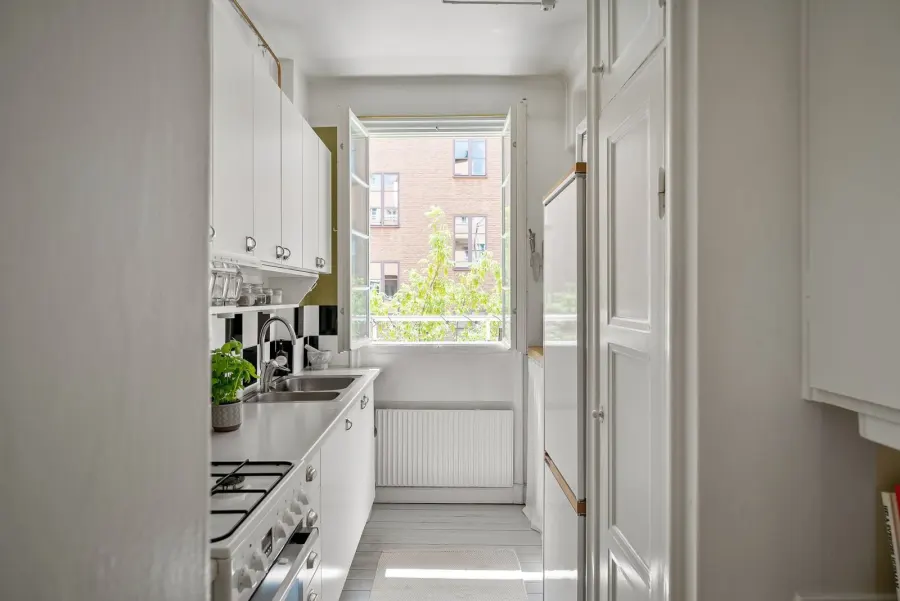
A small kitchen is the norm in London flats and terraces, and the good ones are won on millimetres rather than mood boards. Here are the dimensions that decide what fits, what to leave out, and what a compact kitchen costs to do properly.
Which layout fits your room width?
Room width picks the layout before taste does. Base units are 600 mm deep under a 600 to 620 mm worktop, so every layout is that figure plus whatever gangway is left.
| Room width | Layout that fits | Note |
|---|---|---|
| Under 1,800 mm | Single run | 600 mm of units plus a 1,000 to 1,200 mm walkway |
| 1,800 to 2,100 mm | Single run, tall units one end | Too narrow for a galley: two 500 mm doors need 1,000 mm |
| 2,200 to 2,600 mm | Galley | 600 + 1,000 to 1,200 + 600 mm |
| 2,400 mm each way | L-shape | Frees a wall for a table |
| 2,700 mm plus | L-shape with peninsula | Clearance on two sides, not four |
| 3,650 mm plus | Island becomes possible | Below this, do not attempt one |
The galley figure is the one to memorise. At 1,200 mm two people pass and an oven door projecting 500 mm still leaves somewhere to stand. At 900 mm a dishwasher door meets an open cupboard opposite, which is why narrow galleys feel unusable rather than merely small.
How much worktop do you actually need?
Protect one clear stretch of 900 to 1,000 mm between hob and sink, then let everything else compete for the rest. A kitchen with 2,400 mm of worktop broken into four 400 mm slivers works worse than one with 1,800 mm in two useful pieces.
- Either side of the hob: 300 mm of landing minimum, 400 mm better. Never run a hob into a corner or hard against a tall unit.
- Beside the sink: 400 mm on at least one side for draining.
- In front of the oven: 1,000 mm clear, so the door opens with someone standing there.
- Corners: a standard L corner loses 300 to 400 mm of usable run without a carousel or pull-out mechanism.
Where the storage actually comes from
Height, not cleverness. A run of 2,150 to 2,300 mm tall units holds roughly twice what a base unit and a wall unit hold over the same length of wall, because it uses the dead band above the wall units and the gap beneath them.
- Drawers rather than base cupboards: you see the back of a 600 mm drawer, never the back of a 600 mm cupboard.
- A pull-out larder at 300 or 500 mm wide, reached from both sides, beats a 600 mm cupboard.
- Made-to-fit end panels around chimney breasts and alcoves, which rarely land on 300 mm increments in a London terrace.
Where the room cannot hold everything, move the bulk out of it: a washing machine relocated to a hallway cupboard or small utility space frees an entire 600 mm bay. More in our storage ideas for London homes.
Which appliances to shrink
Shrink what you use least and keep full size what you use daily. Standard UK widths are 600 mm for a dishwasher, washing machine, oven and hob.
- Dishwasher: 450 mm slimline takes 9 to 10 place settings against 12 to 14.
- Oven: a 450 mm high combination oven and microwave replaces a 595 mm single oven plus a separate microwave.
- Hob: two 300 mm domino units, or a 590 mm induction with a flex zone.
- Fridge freezer: a 1,220 mm unit under a worktop-height run instead of a 1,780 mm tall housing.
- Extraction: the one not to shrink. Approved Document F asks for 30 litres per second adjacent to the hob, or 60 litres per second elsewhere, and a small room concentrates steam and grease rather than dispersing it. Duct outside wherever the wall allows.
Light, colour and the illusion of space
Fix the lighting before the colour. Under-cabinet LED at the front edge of the wall units removes the shadow you otherwise cast over your own chopping board, the most common complaint in a compact kitchen and the cheapest to design out. After that: pale low-sheen finishes on the tall run so the bulk recedes, a reflective splashback, one darker colour on the base units so a galley does not read as a corridor, and handleless doors that stop a narrow run catching hips and sleeves. See our lighting guide and maximising natural light.
What does a small kitchen cost in London?
A small London kitchen to a standard specification runs £12,000 to £20,000, roughly £1,300 to £1,800 per m². Per square metre a small kitchen is the dearest kind, because the same five trades attend whatever the size of the room.
| Item | London cost | Note |
|---|---|---|
| Small kitchen, standard spec | £12,000 to £20,000 | Units, worktop, appliances, all trades |
| Rate per m² | £1,300 to £1,800 | £900 to £1,200 in a large kitchen |
| Kitchen fitter, day rate | £300 to £450 | £200 to £300 outside London |
| Moving the sink and waste | £500 to £3,000 | The decision that most moves the total |
Leaving the sink and waste where they are is the biggest single saving available, because moving them means lifting the floor. Full breakdown in our kitchen renovation cost guide. Where the room cannot be made to work at all, an open-plan kitchen-diner is the structural answer. See kitchen renovation London, or contact us on 07472 424 226.