Key Takeaways
- Allow 700 mm of clear floor in front of every fitting. That single figure decides most small bathroom layouts.
- The smallest workable enclosure is 760 x 760 mm; 900 x 900 mm is the one people are happy with.
- A wall-hung WC does not create space, it moves the cistern into a 200 to 230 mm duct.
- Moving the WC is limited to a 6 m branch at 18 to 90 mm of fall per metre (Approved Document H).
- A small London bathroom runs £5,500 to £8,000, with an en-suite averaging £8,100 (MyJobQuote, 2026).
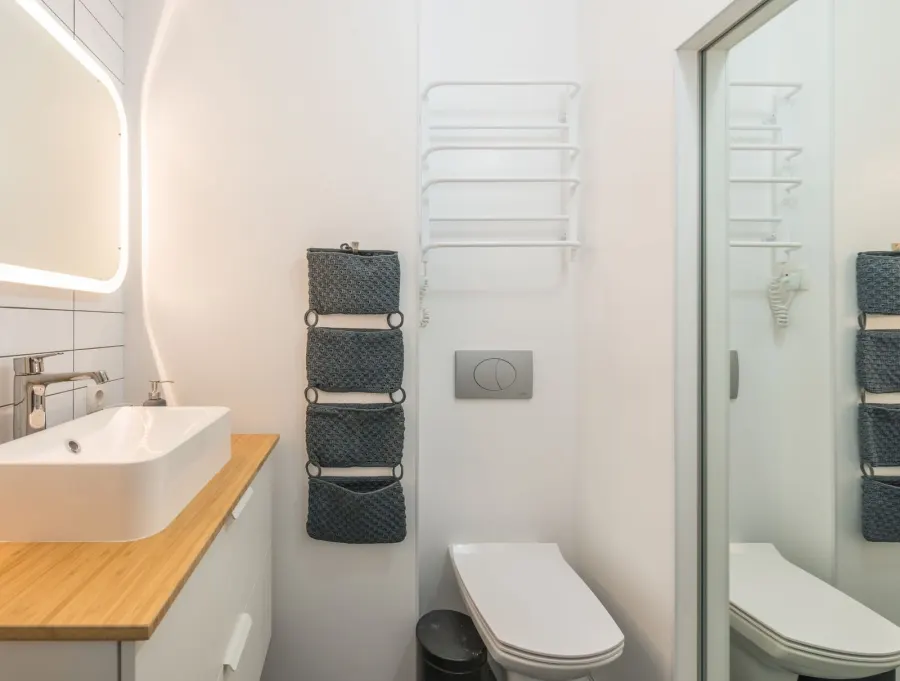
London is a city of compact bathrooms, and the difference between a good one and a bad one is usually 100 mm in the right place. Here are the fitting sizes, clearances and drainage limits that decide what your room can hold, before any of the styling matters.
How do you make a small bathroom feel bigger?
Start with the 700 mm of clear floor every fitting needs in front of it. Most small bathrooms fail not because the fittings are too large but because two 700 mm activity zones are trying to occupy the same square metre.
| Fitting | Typical size | Space it needs |
|---|---|---|
| Close-coupled WC | 360 to 400 mm wide, 600 to 700 mm deep | 700 mm in front, 200 mm each side of centre |
| Wall-hung WC | 500 to 560 mm deep, plus a 200 to 230 mm frame behind | 700 mm in front |
| Basin | 400 to 600 mm wide, 350 mm cloakroom | 700 mm in front |
| Bath | 1,700 x 700 mm, or 1,500 mm space saver | 700 mm along the open side |
| Shower enclosure | 760 x 760 mm minimum, 900 x 900 mm comfortable | 700 mm in front of the door |
| Walk-in shower | 1,200 x 800 mm | No door swing, so it suits tight plans |
Two points before you specify. A wall-hung WC does not save floor area: it hides the cistern in a duct 200 to 230 mm deep, so it pays only where a boxed pipe run already exists. And an inward-opening 762 mm door sweeps roughly 0.6 m², a fifth of a 3 m² room, so hang it outward or fit a slider. The visual tricks then work: wall-hung units, large-format tiles, a frameless screen and one large mirror. See bathroom tile ideas.
What the soil stack lets you move
Drainage sets the limits on any new layout, and it is why a small change becomes a large bill. Approved Document H caps how far each appliance sits from its connection.
- WC: a 100 mm branch, maximum 6 m, falling 18 to 90 mm per metre.
- Bath and shower: 40 mm waste to 3 m, or 50 mm to 4 m, falling 18 to 44 mm per metre.
- Basin: 32 mm waste, maximum 1.7 m unventilated.
- Traps: a 75 mm water seal, or 50 mm discharging straight to a gully.
The WC is the fixed point and everything else negotiates around it, so keeping it put and rotating the basin and shower is the cheapest good layout available. Moving the stack puts a job into four figures and in a flat needs the freeholder's consent. Our guide to adding a downstairs toilet covers the same rules.
Shower, bath, or both?
In a room under about 4 m² a walk-in shower beats a bath on every measure except resale, because it removes the fixed 1,700 mm dimension that forces every other fitting into what is left. Keep a bath if this is the only bathroom in the house and you may sell to a family, in which case a 1,700 x 850 mm shower-bath is the honest compromise. Where level access matters, a wet room removes the tray and threshold altogether, at the cost of full tanking.
Storage that does not steal floor
Build it into the wall thickness rather than onto the floor. A niche recessed between studs at 400 mm centres gives about 350 mm of clear width and the depth of the stud, and costs almost nothing while the wall is open.
- Niches in stud walls only. You cannot recess into a solid party or external wall without structural work.
- A mirrored cabinet at 120 to 150 mm deep gives storage and reflection from the same wall.
- A 400 mm deep vanity instead of the standard 500 mm, enough for a compact basin and 100 mm back to the room.
More in our storage ideas for London homes.
Which regulations apply to a bathroom refit?
Three, and all are enforceable. Electrics and ventilation are where small bathrooms most often fall short.
- Electrical zones. BS 7671 Section 701 sets Zone 0, inside the bath or shower, at IPX7 and 12 V SELV only; Zone 1 to 2,250 mm above floor at IPX4 minimum; Zone 2 a further 600 mm. In a shower with no tray, Zone 1 is a 1,200 mm radius from the outlet. All circuits need 30 mA RCD protection and the work is notifiable under Part P.
- Ventilation. Approved Document F asks for 15 litres per second from an intermittent extract fan, or 8 litres per second continuous. That is what keeps the grout and paint alive.
- Heating. An electric underfloor mat adds 3 to 5 mm to the build-up and frees the wall a radiator would take. See our underfloor heating guide.
Light and colour
Layer the light and the colour choice becomes easy. A small bathroom wants an IP-rated ceiling light, a mirror light at eye level so faces are lit from the front rather than above, and one accent light, each rated for its zone. Pale even tones with a single darker floor keeps the room calm, and a mirror opposite the window beats any paint colour.
What does a small bathroom cost in London?
A small London bathroom to a standard specification runs £5,500 to £8,000, and an en-suite averages £8,100. Halving the floor area never halves the price, because a 2 m² en-suite needs the same plumber, electrician, tiler and fitter as a 7 m² family bathroom.
Source: MyJobQuote and HomeOwners Alliance, 2026. London rates per our bathroom renovation cost guide.The two decisions that move the total are whether the soil connections stay put and how much of the room is tiled. See bathroom renovation London, or contact us on 07472 424 226.