Key Takeaways
- Porcelain absorbs under 0.5% water, ceramic 3 to 10%. That single figure decides floors and showers.
- Supply prices: ceramic £12 to £50 per m², porcelain £50 to £100, marble £40 to £70, granite £80 to £90 (MyJobQuote, 2026).
- Wall tiling labour runs £20 to £40 per m² nationally, more in London.
- Backgrounds have weight limits: plaster 20 kg/m², 12.5 mm plasterboard 32 kg/m², foam tile backer board 60 kg/m².
- Grout is not waterproof. The membrane behind the tile is what keeps water out.
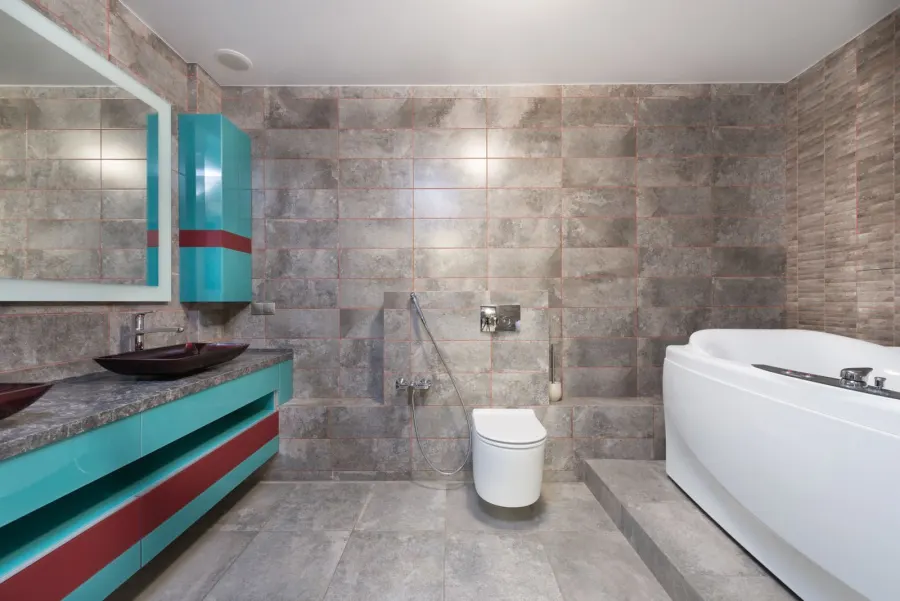
Tiles set the mood of a bathroom, and the right choice makes a modest room look expensive. But half the decisions that matter are not about the look: format, water absorption, what the wall behind can carry, and where the joints go.
Which formats are people specifying in 2026?
Large format leads, and the sizes have grown. The standard large tile is now 600 x 1,200 mm, with 800 x 800 mm common on floors and porcelain slabs running to 1,200 x 2,400 mm and beyond for a near seamless wall.
- Large-format porcelain, 600 x 1,200 mm and up, for few grout lines and a calm wall.
- Marble-effect porcelain and natural stone where the budget is at the top end.
- Microcement and concrete-effect for a minimal scheme with no joints at all.
- Fluted, textured and zellige tiles at around 100 x 100 mm, used on one wall rather than throughout.
- Metro at 200 x 100 mm and warm, earthy and green tones, which sit well in period London homes.
Large format carries a condition. The bigger the tile, the flatter the background must be: aim for 3 mm under a 2 m straight edge, because a 1,200 mm tile cannot follow an undulating wall and will lip at the joints or sound hollow. On an old London wall that means a skim, a re-render or backer board first. Budget for it, or choose a smaller format.
Porcelain, ceramic or stone?
Porcelain for floors and wet areas, ceramic for walls away from water, stone where you accept maintenance in exchange for the material. Water absorption decides it, not price.
| Material | Water absorption | Supply, per m² | Best use |
|---|---|---|---|
| Porcelain | Under 0.5% | £50 to £100 | Floors, showers, wet rooms, underfloor heating |
| Ceramic | 3 to 10% | £12 to £50 | Walls and splashbacks away from standing water |
| Marble | Porous, needs sealing | £40 to £70 | Feature walls, vanity tops, not shower floors |
| Granite | Low, still sealed | £80 to £90 | Floors and heavy wear |
| Slate | Porous, needs sealing | £40 to £50 | Floors, riven finish gives grip |
Two practical notes. Stone in a shower needs sealing on installation and again periodically, and acidic cleaners etch marble whatever you seal it with. On a floor, check the slip rating rather than the finish name: polished porcelain that looks superb dry is a hazard wet, which is why matt and structured surfaces belong in showers. Porcelain also conducts best over underfloor heating.
What is behind the tile matters more than the tile
Every background has a maximum weight of tiling it can carry, and heavy tiles on the wrong board is the commonest reason a tiled wall fails.
| Background | Maximum tiling weight | Note |
|---|---|---|
| Gypsum plaster | 20 kg/m² | Rules out most stone and thick porcelain |
| 12.5 mm plasterboard | 32 kg/m² | Fine for ceramic, marginal for 10 mm porcelain |
| Foam-cored tile backer board | 60 kg/m² | The correct board for a shower wall |
Run the numbers before you order. A 10 mm porcelain weighs roughly 24 kg/m² and adhesive adds 4 to 6 kg/m², which already brushes the plasterboard limit. A 20 mm marble at about 54 kg/m² cannot go on plaster or plasterboard at all. In a shower, use tile backer board whatever the weight.
Where a feature wall pays
You do not have to tile everything, and the arithmetic favours restraint. A shower wall at 2,400 x 1,200 mm is under 3 m², so a £90 per m² statement tile costs around £270 there. The same tile across a fully tiled 15 m² bathroom is closer to £1,350 before labour.
Put the expensive tile where it is seen and wet, plain porcelain elsewhere, and a moisture-resistant paint above 1,200 mm on the dry walls. What you must not do is part-tile a wet area: showers and the splash zone around a bath are fully tiled and fully waterproofed, or they leak. See our wet room guide.
Grout, joints and the joints people forget
Grout colour changes the look more than the tile does, but the joints that matter most are the ones nobody chooses. Matching grout reads calm; contrasting grout, dark against metro tiles, reads graphic and shows every setting-out error.
- Joint width: 2 mm for rectified large format, 3 mm for pressed tiles with a softer edge. Butt-jointing invites cracking.
- Grout type: cement-based for most work, epoxy in showers and on shower floors where staining and chemical attack are worst.
- Movement joints: BS 5385-3 wants them at the perimeter of a tiled floor, including thresholds, and at 8 to 10 m intervals in larger areas. Internal vertical corners take a flexible sealant, never grout.
- Silicone, not grout, at every change of plane: wall to floor, wall to bath, wall to tray.
Grout is not a waterproofing layer. It resists water, it does not exclude it. What keeps water out of the structure is the tanking membrane behind the tile, which is why a shower that looks perfect can still be wetting the joists.
What does tiling a bathroom cost?
Tiling a small bathroom runs £300 to £700 and a fully tiled medium bathroom in ceramic £900 to £2,050, supply and fit. Labour is where London differs most.
| Item | Cost | Note |
|---|---|---|
| Wall tiling labour | £20 to £40 per m² | National rate, higher in London |
| Supply and fit, all in | £35 to £140 per m² | Driven by the material |
| Tiler day rate | £150 to £200 | £220 to £350 in London |
| Small bathroom, tiled | £300 to £700 | Ceramic, walls and floor |
| Medium bathroom, fully tiled | £900 to £2,050 | Ceramic. Porcelain and stone cost more |
Two costs the tile price does not show: preparing an out-of-true London wall for large format, and cutting. Allow 10 to 15% extra material on a patterned or large-format layout. See small bathroom ideas for compact formats, flooring options compared for the rest of the house, and bathroom renovation London, or contact us on 07472 424 226.