Key Takeaways
- London extensions cost roughly £2,000 to £3,500 per m² for standard work, rising to £3,000 to £5,000 per m² for premium finishes (Architecture for London, 2026).
- A typical London side-return extension costs £55,000 to £85,000, and more for larger or premium projects.
- English councils approve around 90% of householder planning applications, a rate stable between 88% and 91% for five years (gov.uk planning statistics).
- Many extensions fall under Permitted Development and need no full planning application, but most London side returns do require one.
- Approval rates vary by borough: Kensington & Chelsea approves around 92.5%, Brent around 76%.
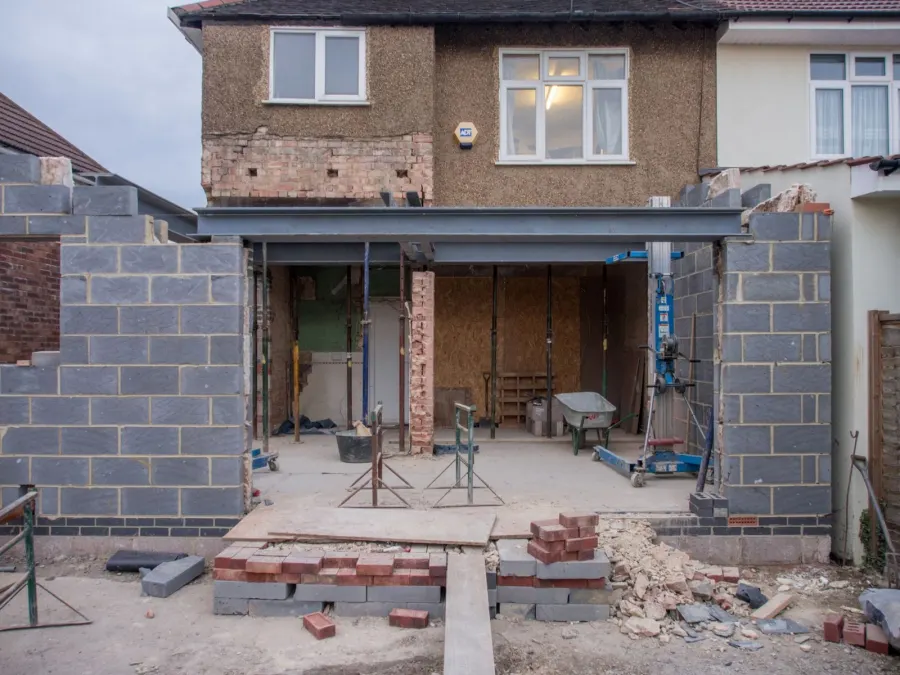
An extension is one of the best ways to add space and value to a London home, but costs and planning rules vary widely. This guide covers what extensions cost per square metre and by type in 2026, when you need planning permission, current approval rates by borough, the party wall and VAT rules to watch, and how long the whole process takes.
How much does a house extension cost in London?
A house extension in London typically costs £2,000 to £3,500 per square metre as a build rate for standard work, excluding VAT and professional fees. So a 20 m² single-storey rear extension commonly lands between £45,000 and £90,000 once design, structural work and finishes are included. Architecture for London's 2026 guidance quotes a higher £3,000 to £5,000 per m² for a London single-storey extension, and states that its figures are for construction only, excluding VAT and professional fees. Both are build rates, so the gap is specification and location rather than what is counted: the upper end reflects architect-led schemes with a high finish in inner London, while the lower end reflects standard work across Greater London. Ask any quote which end of that it sits at, and whether VAT and fees are inside or outside the number, before you compare it with another.
| Finish level | Cost per m² (London) |
|---|---|
| Standard | £2,000 to £2,800 |
| Mid-range | £3,100 to £3,700 |
| Premium | £4,300+ |
Extension costs by type
The right type of extension depends on your property and how you use it. Side returns and rear extensions are the most common in London's terraced housing, while wrap-arounds and double-storey extensions deliver the most space.
| Extension type | Cost per m² | Typical London total |
|---|---|---|
| Single-storey rear | £2,000 to £2,800 | £45,000 to £90,000 |
| Side return | £2,400 to £3,200 | £55,000 to £85,000 |
| Wrap-around | £2,400 to £3,200 | £80,000 to £140,000 |
| Double-storey | £1,800 to £2,600 | £90,000 to £180,000 |
| Loft conversion (alternative) | £1,250 to £2,500 | £25,000 to £100,000+ |
A double-storey extension has a lower cost per m² because the roof and foundations are shared across two floors, which is why it is often the better value per room. A loft conversion is the alternative that does not use up garden, and it is more often permitted development. See extension versus loft conversion and does a loft conversion add value if you are weighing the two, or basement conversion costs if going down is the only direction left.
Almost every extension that opens up the ground floor needs a steel beam where a wall is removed. Our guide to RSJ installation explains that element in detail. See also our house extensions service in London.
Do you need an architect and drawings?
For anything beyond the simplest extension, yes. You will need measured drawings for both the planning application (where required) and Building Control, plus structural engineer's calculations for beams and foundations. Professional fees, including design, structural engineering and any planning or party wall surveyors, typically add 10 to 15% on top of the build cost. A design-and-build contractor can manage all of this under one roof, which avoids the gaps that appear when separate parties hand off to each other.
Planning permission vs permitted development
Not every extension needs planning permission. Many single-storey rear extensions fall under Permitted Development rights, which allow you to build within set limits without a full application. However, most London side returns, projects in conservation areas, listed buildings, and double-storey extensions usually require full planning permission from your local council.
Because the rules turn on plot width, conservation status and how much you have already extended, the safest first step is a professional assessment. We check your property's permitted development potential and planning history before recommending a route. Our guides to permitted development rights, the larger home extension prior approval route and getting planning permission in London set out each one, and a lawful development certificate is worth £274 to prove the work was lawful when you sell.
Conservation areas and listed buildings
Large parts of London, especially in boroughs like Kensington & Chelsea, Westminster, Camden and Islington, sit within conservation areas, and many homes are listed. In these areas, permitted development rights are usually restricted or removed, materials and design are scrutinised more closely, and listed buildings need separate listed building consent for many changes. It is still very possible to extend, but the design has to respect the character of the area, and early conversations with the planning department pay off. We work across every London borough and tailor each application to local conservation policy.
What are the planning approval rates in London?
The odds are good. Local authorities across England granted around 90% of householder planning applications in the quarter ending December 2025, and that rate has held between 88% and 91% for five years, according to government planning statistics. Rear extensions are approved at above 85% in most councils.
Approval rates do vary by borough, though. Kensington & Chelsea approves around 92.5% of applications, while Brent sits closer to 76%. A well-designed application that respects the local character and neighbours is far more likely to succeed, which is why design quality matters as much as ambition.
Source: gov.uk planning application statistics for England, quarter ending December 2025.Party wall agreements and hidden costs
Two costs catch London homeowners out. The first is the Party Wall etc. Act 1996: if you build on or near a boundary, or excavate close to a neighbour's foundations, you must serve notice two months before starting, and a party wall award adds a few weeks and surveyor fees. Our party wall guide explains the notices. The second is VAT: most extension work is standard-rated at 20%, so always confirm whether a quote includes it, and see VAT on renovations for the exceptions.
| Fee or extra | Cost | Notes |
|---|---|---|
| Householder planning application | £548 | England, from 1 April 2026, flat rate |
| Prior approval, larger rear extension | £249 | The 6m and 8m permitted development route |
| Lawful development certificate | £274 | Proof the work was permitted development |
| Planning Portal service charge | £75.83 plus VAT | Avoidable if your council takes payment directly |
| Party wall surveyor, extension | £1,200 to £1,500 | Per adjoining owner, single agreed surveyor |
| Professional fees | 15 to 20% of build cost | Architect, structural engineer and consultants |
Also budget for building control fees, structural calculations, drainage or utility diversions, a Thames Water build over agreement where a public sewer runs close by, and a contingency of at least 10%.
How long does an extension take?
Allow time for the full journey, not just the build. A single-storey London extension usually takes 10 to 16 weeks on site, preceded by several weeks for design, planning and structural calculations. A full planning application typically takes around 8 weeks for a decision once validated.
- Design & drawings: 2 to 4 weeks
- Planning decision (if required): around 8 weeks
- Structural calculations & building control: 1 to 3 weeks
- Party wall notices (if required): allow up to 2 months
- Construction: 10 to 16 weeks for single-storey
GS Renovation manages the entire process, from drawings and planning through to structure and build, across London. For a free assessment of what your property can support, contact us or call 07472 424 226. Adding a kitchen-diner? See our kitchen renovation cost guide.