Key Takeaways
- A typical bath uses about 80 litres. A standard shower head at 10 litres a minute matches that in eight minutes, and a power shower beats it (Waterwise, 2025).
- Building Regulations do not require a bath. Approved Document G asks only for a wash basin and "either a fixed bath or a shower".
- The case for keeping one is commercial: 45% of buyers call no bath a dealbreaker, and nearly half of agents put the value cost at 3% to 4% (Drench, 2026).
- A walk-in shower runs £1,000 to £5,500; a full wet room averages £5,500 nationally and £10,000 to £18,000 as a complete London room; a bath installed is about £700 (MyJobQuote and Checkatrade, 2026).
- Electric showers need 1 bar of pressure, ten times a thermostatic mixer. They are not the low-pressure answer people assume.
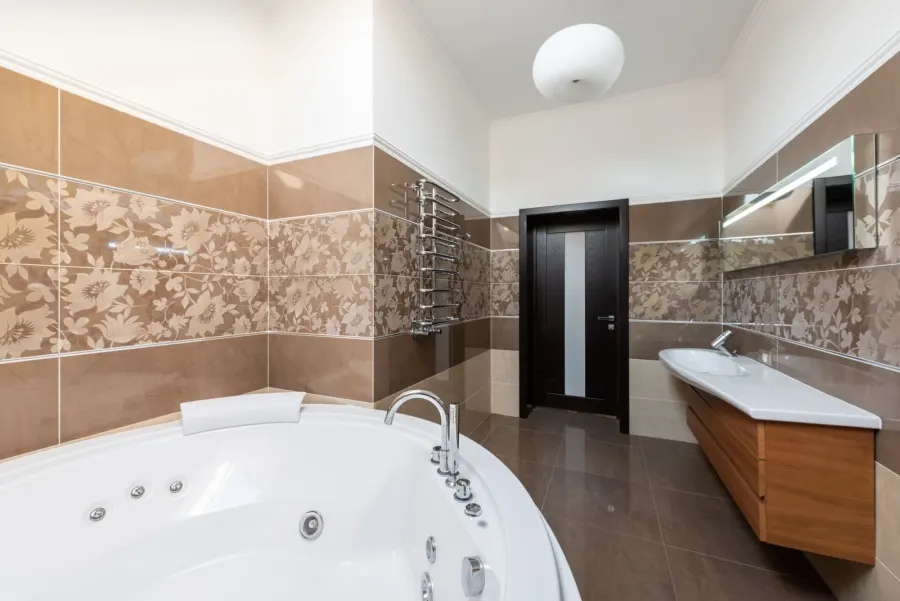
Bath, shower, or both? It is one of the first decisions in any bathroom project, and the usual advice ("keep a bath for resale") is right for the wrong reasons. Here is what the water use, the regulations, the costs and the only real UK survey data actually say.
Which actually uses less water?
It depends entirely on the shower head, and most people assume wrongly. Waterwise puts a typical bath at 80 litres, which is a normal fill rather than a brimming 1700mm tub, and notes plainly that a power shower uses more water than a bath.
| Option | Water used | Notes |
|---|---|---|
| Bath | about 80 litres | A normal fill, not a full tub |
| Eco head, 6 litres per minute | about 45 litres | The only option that clearly beats a bath |
| Standard head, 10 litres per minute | about 75 litres | Roughly a bath |
| High-flow head, 15 litres per minute | about 113 litres | Well over a bath |
| Electric shower, 8.5kW | about 30 litres | Delivers only about 4 litres a minute |
Cost follows volume if you are metered. Thames Water charges £4.21 per m³ for water and wastewater combined from April 2026, so an 80 litre bath is roughly 34p in water before you heat it. Heating is the larger share: on the Ofgem cap for July to September 2026 (the cap is reset every quarter, so check the current unit rate), gas at 7.33p per kWh puts the energy in that bath at around 23p, so call it 55p to 60p all in. Treat those as indicative, because the cap moves quarterly.
The case for a shower
A walk-in shower is faster, easier to clean and frees floor area in a compact London bathroom, and in an en-suite or second bathroom it is almost always the better use of space. Crucially, Building Regulations are on your side: Approved Document G requires only "a wash basin and either a fixed bath or a shower". Removing your only bath is entirely lawful. A generous shower or wet room also suits anyone thinking ahead about mobility.
The case for a bath
A bath is better for young children, for soaking, and for the accessibility case people get backwards. Approved Document M actually requires a bath in accessible and adaptable dwellings, treating a level access shower as additional provision rather than a substitute, though that standard only applies where a planning condition imposes it. If you have small children or elderly relatives who visit, a bath is not nostalgia, it is the practical fitting.
What about resale?
Keep at least one. The only quantified UK survey on this is the Great British Bath Report 2026, Censuswide fieldwork with 250 estate agents and 2,000 consumers, and it is worth noting it was commissioned by a bathroom retailer. It found 45% of people call the absence of a bath a dealbreaker when house-hunting, 47% of agents believe a home without a bath loses 3% to 4% of its value with a further 25% putting it at 5% to 6%, and 34% say family homes without a bath take three to four weeks longer to sell.
Be honest about the limits of that: there is no equivalent research from Rightmove, Zoopla, Nationwide or Savills. Treat it as directionally useful rather than as a valuation.
Source: Drench Great British Bath Report, Censuswide, 2026 (retailer-commissioned).What each option costs
| Job | Typical cost, 2026 |
|---|---|
| Bath, supplied and installed | around £700 (acrylic bath £170 to £340, labour £280 to £390) |
| Shower enclosure, supplied and fitted | £250 to £750 |
| Walk-in shower, basic to frameless | £1,000 to £5,500 |
| Full wet room | UK average £5,500, from £4,675 small to £8,360 large; £10,000 to £18,000 as a complete London room |
| Whole new bathroom, London | £6,000 to £20,000+; most mid-range family bathrooms £7,500 to £12,000 |
The wet room number is where projects overrun. Tanking a whole room costs £300 to £800 on top of the tray former, drain and screen, and London bathroom labour runs £250 to £350 a day against £180 to £250 elsewhere. Do not economise here: escape of water is one of the most common domestic insurance claims in the UK, with the ABI reporting insurers paying out around £1.8 million a day. See our bathroom cost guide.
Space, pressure and the rules that bite
A standard bath is 1700mm by 700mm. Approved Document M works to clear access zones of 700mm by 1100mm in front of a bath and 1000mm by 1000mm for a shower, which is a better planning guide than enclosure catalogues. A level access shower to the wheelchair standard is 1200mm by 1200mm, and any room containing one has to be built as a wet room.
Two more points worth knowing. Pressure: electric showers need about 1 bar and 8 to 11 litres a minute at the inlet, while a thermostatic mixer will work from 0.1 bar. If your pressure is poor, an electric shower is the wrong answer and a pumped or low-pressure-rated mixer is the right one. Electrics: removing the shower tray in a wet room widens the notifiable zone under Part P from 0.6m from the tray edge to 1.2m from the shower head, so the electrical work needs notifying. See small bathroom ideas.
Source: Approved Documents M and P, Triton and Mira technical data, 2013 to 2026.The verdict
In any house with two or more bathrooms, keep a bath in the main bathroom and fit walk-in showers everywhere else. That is the answer for most London family homes and it costs you nothing in resale. In a one-bathroom family house, keep the bath, and fit a good thermostatic mixer over it rather than losing the tub. In a one-bathroom flat aimed at professionals or downsizers, a proper walk-in shower is defensible, and often better day to day, provided you accept you are narrowing the buyer pool. Whatever you choose, spend the money on the tanking and the drainage rather than the glass.
GS Renovation designs and builds bathrooms, en-suites and wet rooms across London, including bathroom renovation in London. For a free quote, contact us or call 07472 424 226.