Key Takeaways
- Installed averages are £375 per m² for quartz and £435 per m² for granite. Marble runs £400 to £1,000+ per m² (MyJobQuote, 2026).
- Quartz is non-porous and never needs sealing, but its resin binder scorches, so it is the least heat resistant of the three.
- Granite takes a hot pan straight off the hob but is porous and wants resealing every 12 to 18 months.
- Marble is Mohs 3 to 4 and etches on contact with lemon, vinegar or wine. It is the wrong surface for most working kitchens.
- Choose on how you cook, not on the slab in the showroom.
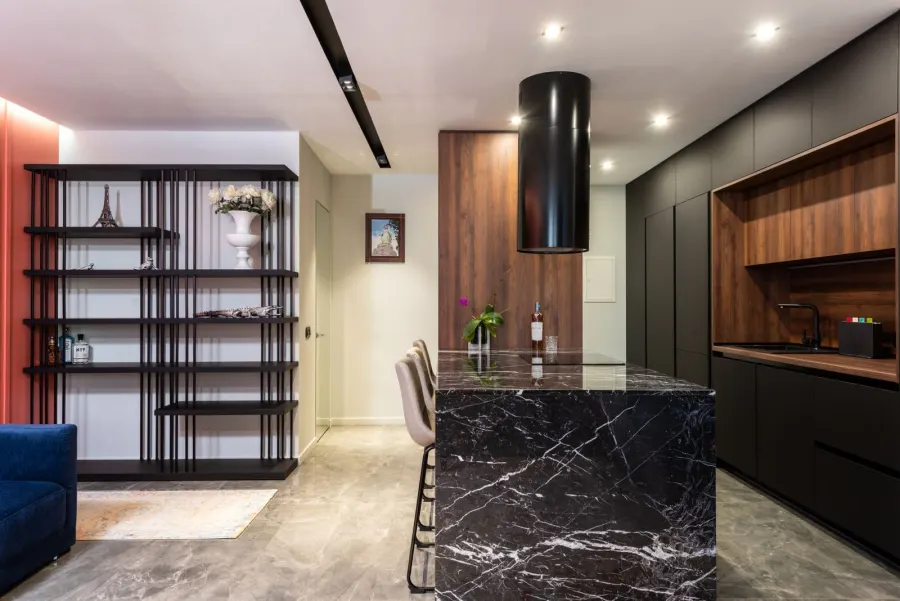
The worktop is the surface you use every day and one of the biggest visual statements in a kitchen, so choosing between quartz, granite and marble matters. This guide compares them on cost, durability, maintenance and looks to help you decide.
Cost compared
Quartz and granite land within about £60 per m² of each other once fitted, and marble sits well above both. The ranges below are supply and fit per square metre, including templating, fabrication and installation, and the spread inside each material is grade rather than type: a budget quartz and a designer quartz are further apart than quartz and granite are.
| Material | Supply and fit, per m² | Installed average | Labour for a 5m run |
|---|---|---|---|
| Quartz | £220 to £900 | £375 per m² | £600 to £1,500 |
| Granite | £270 to £600 | £435 per m² | £800 to £1,500 |
| Marble | £400 to £1,000+ | Designer slabs sit well above | £800 to £1,500 |
How do they compare in use?
The three differ far more in behaviour than in price. Hardness, porosity and heat tolerance decide which one survives your kitchen.
| Property | Quartz | Granite | Marble |
|---|---|---|---|
| Composition | Engineered, around 90% crushed quartz in resin | Natural igneous stone | Natural metamorphic stone |
| Mohs hardness | About 7 | 6 to 7 | 3 to 4 |
| Porosity | Non-porous | Slightly porous | Porous |
| Sealing | Never | Every 12 to 18 months | Every 6 to 12 months |
| Heat resistance | Moderate, the resin scorches | Excellent, takes a pan off the hob | Good, but marks show |
| Stain and acid resistance | Excellent | Good once sealed | Poor, etches on contact with acid |
| Repairability | Colour-matched resin, specialist job | Chips fillable, can be re-polished | Etches and scratches can be honed out |
Quartz: the low-maintenance favourite
Quartz is engineered from roughly 90% crushed natural quartz bound in resin, which makes it non-porous, stain resistant and consistent in colour and pattern. It never needs sealing, wipes clean with soap and water, and is the easiest of the three to live with, which is why it is the default in busy London kitchens. It is also the only one you can order twice and get the same thing, which matters when a slab has to match an island.
The trade-off is heat. The resin binder softens and discolours well below the temperature the mineral could take, so a roasting tin straight from a 200°C oven can leave a permanent mark that no amount of polishing removes. Use trivets, and do not run quartz right up against a hob without a heat-resistant strip. A chip in quartz is repaired with colour-matched resin by a specialist rather than by re-polishing, so it is not the material for a household that drops things.
Granite: natural and tough
Granite is the most heat tolerant of the three and the only one you can genuinely put a hot pan on. It is a natural igneous stone at Mohs 6 to 7, so it resists scratching about as well as quartz, and every slab is unique, which is either the appeal or the problem depending on whether you want to see the slab before it is cut. Ask to view the actual slab, not a sample.
The price of that durability is maintenance. Granite is slightly porous, so it wants resealing every 12 to 18 months with a proprietary sealer, a job that takes twenty minutes. Skip it and red wine, turmeric or oil will find the microscopic pores, particularly on lighter and more open-grained stones. Clean it with a pH-neutral cleaner rather than anything acidic, which strips the seal.
Marble: luxury with care
Marble is the most beautiful of the three and the wrong choice for most working kitchens, and it is worth being blunt about why. At Mohs 3 to 4 it is roughly half as hard as granite, so it scratches. More importantly it is calcium carbonate, which means acid dissolves it: a splash of lemon juice, vinegar, wine or tomato sauce leaves a dull etch in the polish within minutes. That is a chemical reaction, not a stain, so no sealer prevents it and no cleaner removes it. Sealing slows absorption and does nothing about etching.
Marble is right if you genuinely want the patina, if you will reseal every 6 to 12 months and wipe spills immediately, or if you use it where food is not prepared. The sensible compromise we fit most often is marble on a feature island or a pastry section and quartz on the working runs, which gives you the veining you paid for on the surface people see and a bombproof surface beside the hob. Honing the finish rather than polishing it also makes etches far less visible.
How to choose
Choose on how you cook, because all three look good on day one and only one of them still looks good in year five of a family kitchen.
- Choose quartz for a busy family kitchen, for a colour or pattern you need to repeat across an island, and if you are content to use trivets. It is our default recommendation.
- Choose granite if you cook hard and want to put pans down without thinking, and you will actually do the annual reseal. It is also the better value at the top of the range.
- Choose marble only for a feature island, a low-traffic run, or a household that wants the patina. Do not put it beside a hob you use daily.
Whichever you pick, get the worktop templated after the units are fitted and levelled, never before, and decide the sink type early: an undermount sink needs a different cut-out and edge polish from an inset one and costs more to fabricate.
The worktop is one of the biggest swing factors in a kitchen renovation budget, and it interacts with the layout, so read the island guide and open-plan kitchen-diner ideas before you commit. In a smaller room, see small kitchen ideas. GS Renovation designs and installs kitchens with all three across London: see kitchen renovation in London, contact us or call 07472 424 226.